For many of us who come from Protestant backgrounds, overcoming resistance to Catholic teaching regarding Mary can take significant time, energy, and discernment. We’re used to trusting only what’s explicitly detailed in the pages of Scripture; so something like the dogma of the Immaculate Conception—which is the fruit of the Church’s extended reflection through time on the reality of the incarnation of Jesus—can take a while to warm up to.
Dogmas such as the Immaculate Conception, the Assumption, and others fall under the umbrella of teachings that we must assent to as Catholics. But connected with them, in a mysterious way, is the realm of Marian devotion; a treasury of optional prayers and imagery that can help us enter more deeply into the reality of what the Church believes about the Blessed Mother.
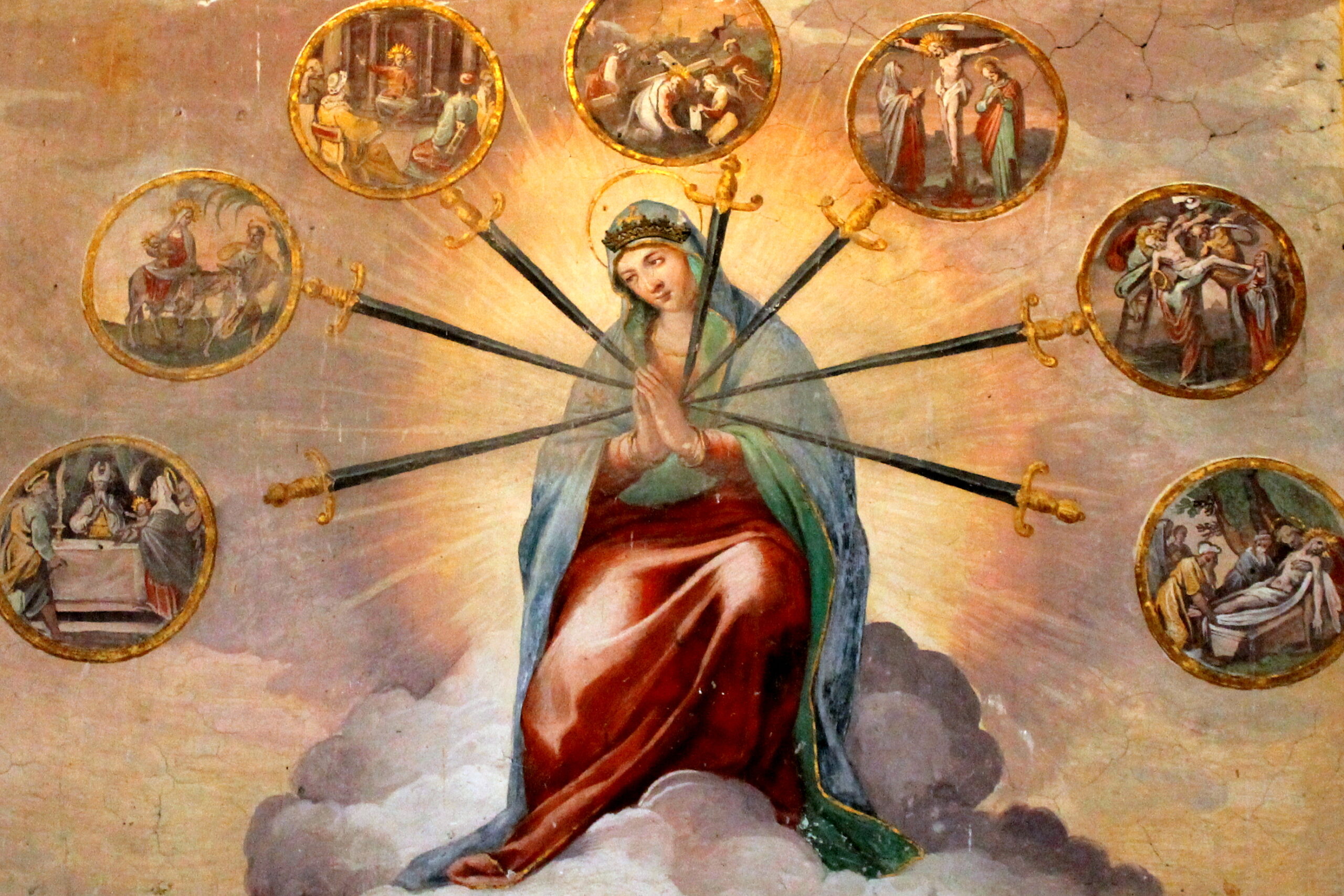
One of these devotions that makes a formal appearance every year on the Church’s calendar is the practice of reflecting on Mary as Our Lady of Sorrows, sometimes also referred to as the Sorrowful Mother devotion, or Mater Dolorosa in Latin. The entire month of September is devoted to Our Lady of Sorrows, with a special feast day that falls on September 15th. While many of the things the Church offers us in regard to Mary come by way of tradition, history, and theological extrapolation, the Seven Sorrows of Mary that make up this devotion are all detailed explicitly in the Bible, rendering them perhaps more approachable to those of us who have always held the Scriptures in high regard.
They are:
1. The Prophecy of Simeon, that a sword would pierce Mary’s heart (Luke 2:34-35)
2. The Flight into Egypt, when the Holy Family escaped from Herod after a warning from the Magi (Matthew 2:13-21)
3. The Loss of Jesus for Three Days, after which Mary and Joseph found him teaching scholars in the Temple (Luke 2:41-50)
4. The Carrying of the Cross, when Mary watched her own son suffer through the streets of Jerusalem (John 19:17)
5. The Crucifixion of Jesus, at which Mary was present, and even directly addressed by Jesus (John 19:18-30)
6. Jesus Taken Down from the Cross, a moment depicted most famously in Michelangelo’s Pieta (John 19:39-40)
7. Jesus Laid in the Tomb, his body having been received by Nicodemus, Joseph of Arimithea, and other women from Galilee (John 19:39-42)
Much like the Stations of the Cross, while there is a specific list of moments to meditate upon, there are various ways to approach this devotion; one form approved by Pope Pius VII involves specific prayers for each sorrow, whereas some Catholics prefer to just reflect quietly for a few moments on each event with the Scriptures themselves, or art depicting the Seven Sorrows.
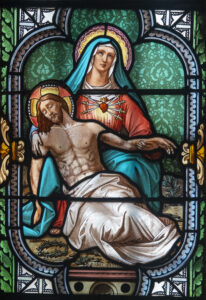
Stained glass (19th century) of Pieta (Madonna of Seven Sorrows). Blessed Virgin Mary holding Jesus Christ body after his Deposition from the Cross.
The key image associated with this devotion consists either of Mary pointing at her heart with seven swords protruding from it (an allusion to Simeon’s prophecy), or, sometimes, just a heart itself, pierced by seven swords.
The Catechism of the Catholic Church tells us that “What the Catholic faith believes about Mary is based on what it believes about Christ, and what it teaches about Mary illumines in turn its faith in Christ.” (CCC 487) This principle is on full display in the devotion to Our Lady of Sorrows. It is precisely Mary’s love for Jesus that makes her heart sorrowful when she hears the foreboding pronouncement from Simeon, or when her family is uprooted and flees to Egypt. And anyone who has ever lost track of their child in a grocery store can deeply identify with what Mary felt when Jesus went missing for three days when he was only twelve years old.
It is important to be attentive to the formal teachings surrounding Mary when making the journey toward the Catholic Church, in order to be able to honestly assent to them. But sometimes what we need to help bridge the gap in our understanding regarding Mary is not more study, but more prayer. And meditating on the life of Jesus through the sorrows of His mother, especially during this month of September, can be a helpful way to better enter into the mystery of His incarnation.