“I tell you these things because this is how we return thanks to God, that after being corrected, and having come to an awareness of God, that we glorify and bear witness to his wonderful works in the presence of every nation under heaven.”
(St. Patrick, Confession)
I grew up in Wheaton, IL (known to some at that time as “the Evangelical Vatican”) in the Orthodox Presbyterian denomination, a conservative offshoot of one of the larger, national Presbyterian denominations. My parents have devoted their lives to serving God and teaching students to love God by learning about his creation. As a child, I was always heavily involved in youth group and mission trips. I made my “decision for Jesus” at an evangelistic youth rally in our town the year our church split. I had always known about Jesus — but I made the choice out of knowledge that choice was necessary, that an active decision on my part was necessary to become a Christian, and I had not yet done so. Later that year, I was baptized and became a “member” of our congregation.
A year later, when I was 13 or 14, our congregation split. Although I was a young teen, it seemed to me that both interpretations of the Scripture passages relating to the church split had valid points. I remember thinking that there was no real way of knowing for certain what the correct interpretation was, and that we had all just chosen the one we liked the best. This experience primed me to be more open to the unity I saw later on, when I experienced Catholicism in Italy.
I didn’t have a lot of encounters with Catholicism at this point in my life, but my grandfather was Catholic, so I knew that Catholics ate fish on Friday and went to confession. However, that was about all I knew, since my mom had grown up going to church in my grandmother’s Methodist church.
Upon graduating from high school, I decided to attend Gordon College, a Non-denominational, yet almost entirely Protestant Christian liberal arts institution, in Massachusetts. While I was there, my desire to be a disciple and servant of Jesus Christ deepened. Some friends took me to visit their Episcopal church during my freshman year. I visited a number of churches that first year of college and felt ambivalent about most of them. But I wanted to return to the Episcopal church: I wanted to kneel to pray and to receive communion, to have my physical actions mirror the attitude of my heart — I wanted to feel the sting of real wine (instead of grape juice!) on my tongue.
For a year or two, I alternated between attending an Episcopal service and a Vineyard service. In both places I found a physicality of worship which I appreciated. I found in both places a diversity of ways in which God revealed himself. By the end of my sophomore year, I was a regular attendant at an Episcopal church near the Gordon campus.
Encounter with St. Peter
My third year of university, I embraced the opportunity to study in Italy: fall semester of 1997 in Florence, and the spring semester of 1998 in Orvieto, Umbria. I wanted to study art and art history abroad, and in Italy I thought I could find the heart of it all: Ancient Greek and Roman art, Medieval art, Renaissance art. Whatever direction my historical interests might take me, I could find art in its original context. I wanted the core of the Western art tradition. I did not realize at the time that I would find it in Catholicism.
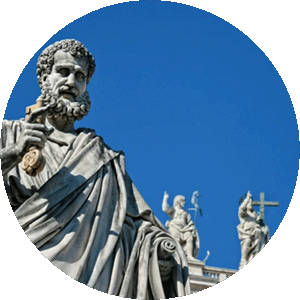
The first few days of that first semester in Italy were a whirlwind tour of the great sites: Pompeii, Rome, Assisi. In those very first days in Rome, we visited St. Peter’s Basilica. Not even the gothic cathedrals of France and England had prepared me for the size of St. Peter’s. Immediately, when I saw the grandeur and scale of the Basilica, I saw the truth of the Gospel verse: “You are Peter, and on this rock I will build my church” (Matthew 16:18). Whether or not I believed that St. Peter was buried there, whether or not I acknowledged the Catholic Church — the fact is that an an entire civilization, the faith of billions of people, was centered in this one building, over one rock: St. Peter. This was my first introduction to the power of Catholic metaphor. Peter was both literally the rock upon which the Church was built, but also figuratively the center of the organization through the papacy.
I felt the holiness of the place. In each chapel, I wanted to stop and pray. At the same time, was it possible for someone to discern the truth of the love of God behind all this ostentatiousness? I wrote in my journal:
In rejecting Catholicism and the use of images in the church, we Protestants rejected a rich resource and tradition of worshipping God. We have stifled art in the church because of our fear of idolatry, and in doing so, we have repressed a beautiful way of worshipping God. At Evangelical colleges like Gordon, we talk about “Christian art” or “using art for the glory of God.” What is it, and how do you do it? Go to the Vatican. The Catholics have it all figured out. There was room upon room of modern religious art at the Vatican — stuff you don’t see in most art museums, stuff I didn’t know was being done because we have divorced ourselves so completely from the Catholic tradition.
It was my first sense that perhaps something had been lost along the way, that there might be a need to “return” to a tradition from which I never knew I came.
Upon settling into the semester in Florence with my new secular college student friends, I felt the emptiness of European secular society, full of darkness, drugs, superficiality, and hollow good times. There was also the literal emptiness of the Masses I attended, sparsely attended by a few elderly people in these massive spaces created for throngs of worshipers. The Catholic Church I saw was dying, full of tired old women led by bored old men living religious traditions empty of spirituality. It made me angry, and I distrusted the institution that was clinging to outdated tradition while ignoring the people who were spiritually needy and falling apart all around it.
In my classes, I worked hard to understand the Renaissance and Medieval images. My knowledge of the Bible greatly aided my understanding of these mostly religious art works, but the beautiful and profound images were detached from my 20th century life. They belonged to a time and place far from my own and they did not speak to my heart immediately.
Encounter With Mary
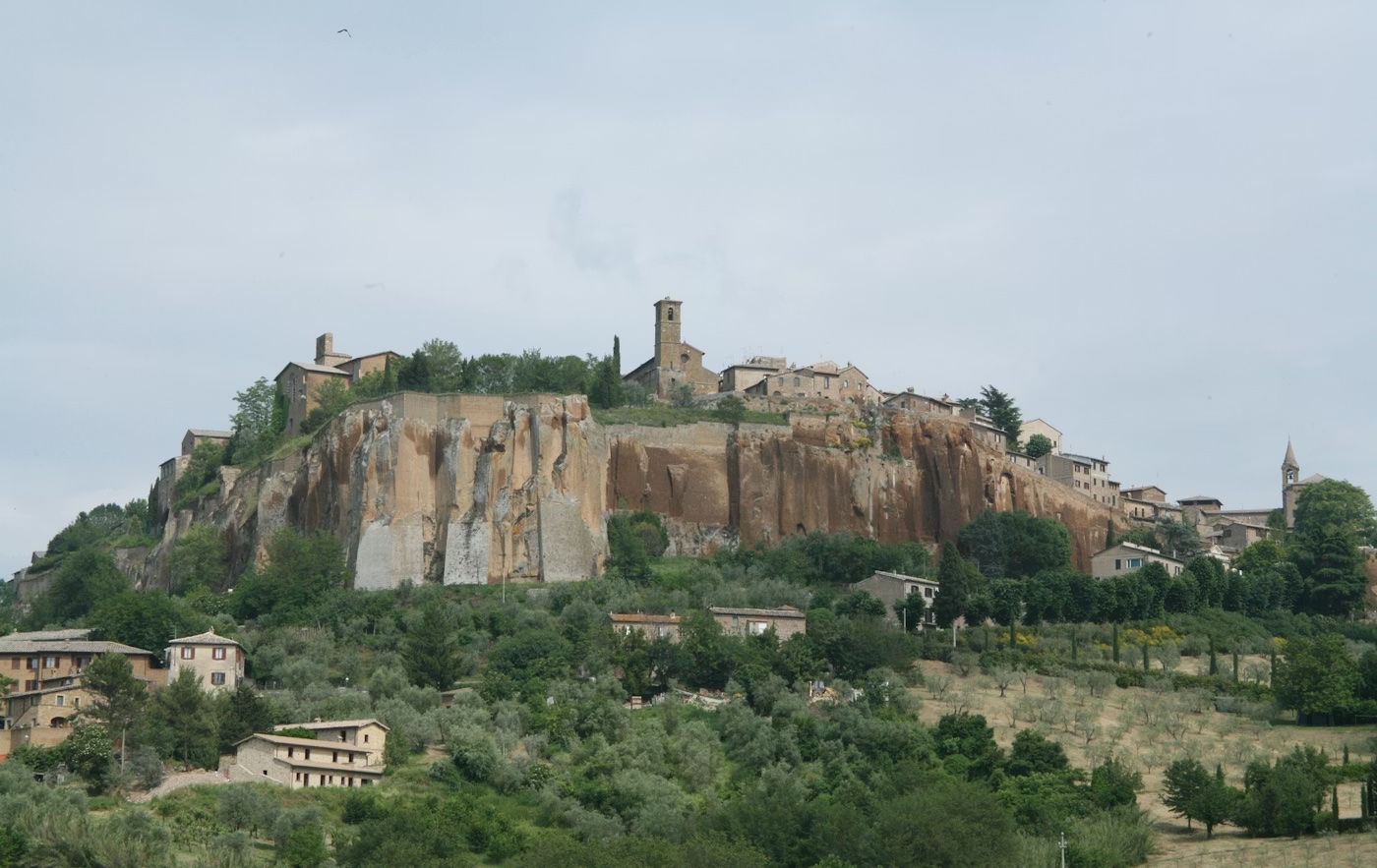
After a semester in Florence, I spent two months traveling the European continent before coming to Orvieto in the spring of 1998, where I was to study as part of the the inaugural semester of the Gordon College-in-Italy program. Our group was to be hosted by the Sisters of the Company of Mary Our Lady. It was an adventure for both the community of sisters (who had never hosted any group for four months, let alone American college students) and for Gordon College. I began to have conversations with Sister Giovanna, the Mother Superior, on a regular basis. She told me about their order, The Company of Mary, the history of the convent, and we talked about faith.
After being in Orvieto for a month or so, I met a woman in the local library who invited me to evening vespers at a nearby convent of the order of St. Clare. The cloistered nuns there gather six times a day to pray, and are separated from the world by an iron grate. “There is a peace there that is not of this world,” my new friend told me.
As I got to know this family better, I found that they had recently experienced profound conversions and were beginning to truly live the faith in which they had been brought up. They were members of a charismatic prayer group, and I asked to go along with them to one of their meetings. I had never experienced prayer in this way before — singing together improvisationally, then falling silent as one person’s prophetic song without words floats above the rest; or the clatter of someone (or several someones) speaking in tongues that drowns out the music of the guitar, and then suddenly all ends with a Scripture passage which God sends to the gathering. Here was the convergence of the two worship experiences I had been drawn to in college: the freedom of the Holy Spirit guarded by the constraints of church tradition and the liturgy.
I was suspicious, cautious of this new way of worship and the emotional power in the room, but I was fascinated. I could not doubt the love in the eyes and in the lives of my new friends — something here had to be real. I went to a charismatic Mass with them, and I saw that the dead traditions of the Catholic Mass I had experienced Florence could also be made new with guitars, with the passion of youth, and with the love of Jesus. He was present here with a force I had never seen before in a worship gathering.
Somehow, in my mind, in what I had been taught, there had always been limits to what God could choose to do. Did the Holy Spirit move now the way it had in the early Church? It had been a matter of debate. Here those limits began to disappear in the vastness of God’s love.
In Orvieto, I saw unity in diversity in a way I never dreamed was possible. Worship with the Poor Clares was a far cry from praying with the charismatic group with their bongos and guitars, but they are one Church, and my friends prayed in both modes, seeing no contradiction, because they shared the love of one Jesus and His one Church.
On Sunday mornings, while we were studying in Orvieto, some of the college students from our Evangelical Christian college group went to Mass. The closest Protestant church was in Rome, so instead, we attended a church which was, at that time, 994 years old. The altar was even older, dating from the 9th Century. We were worshipping just as they had done for years, decades, centuries, for more than a millenium in this same spot. There were only 30 to 40 people in attendance, usually, so we augmented the congregation considerably.
That year in Orvieto, I heard for the first time that one could come to know God most fully through communion by uniting with him physically in the Eucharist. In my Protestant upbringing, communion was a symbol, perhaps even contained a “presence” of God, but the “union” part of communion had never been mentioned. I began to see the immense possibilities of individual and corporate redemption through the love of Jesus Christ dispensed in the Eucharist.
Studying paintings in the context for which they were created, as altarpieces rather than museum pieces, I found new layers and depth I had not seen in viewing art in books. Traveling around Italy as a student, I encountered a huge quantity of artworks depicting the Virgin Mary, and I began to wonder about her. Why was she the central character in so many masterworks? Why was she, and not Jesus, so often above the altar? The charismatic group here was called the Community of Mary (Comunita’ Maria), and I was a guest of the Company of Mary. In the spirituality of these two groups and in the art which surrounded me, I began to see the presence of the Mother of God, to whom I had never given a great deal of thought. Through several Italian friends with a strong Marian devotion, I began to understand her place in salvation history, how the Annunciation is the moment of Incarnation, and how the Incarnation—God coming to earth—happens each day in the Eucharist. This is why the Annunciation is the image of choice above the altar: it focuses on the Incarnation. The focus is Jesus, not Mary.
These narratives were deep and complex, telling a story of a communal worldview, connecting it to what had come before, and by implication, what could and will come later. The physical and metaphorical complexity of such works as the Maitani bas-reliefs on the Orvieto Cathedral, or the Maesta’ altarpiece by Duccio in Siena, pointed to a faith that was more full and multi-faceted than I had previously encountered. These artworks celebrated a humanity that was flesh as well as spirit, story as well as doctrine.
The Maitani reliefs are a visual narrative of salvation history carved in marble on the façade of the cathedral in Orvieto, where I lived and later worked for the study abroad program. There are four panels: Creation, Prophecies of Christ, Life of Christ, and Last Judgement. The design of the creation panel mirrors the panel depicting the end times; prophecy and fulfillment converse through similarities of format and design. Through this work of art I was introduced to typology, a mode of reading Scripture which was new to me. Prophecy wasn’t simply predicting the future but pre-figuring: Old Testament narratives became a model for a story that would be fulfilled through Christ, and could also be fulfilled even in our own lives. Scripture was revealed in a new way, as I discovered that the story of Gideon’s fleece was a type, or model, for the way Mary absorbed the Holy Spirit, and for the way we, in turn, should be open to soaking in the presence of God.
After returning from my junior year abroad, I continued to pursue an academic interest in Mary. During that senior year back at Gordon College, I took a Byzantine history class and researched an icon of the Virgin that was rich in typology. I also did a project on a feminist theology of Mary for a women’s studies course.
After graduating from college, I returned to Orvieto in the fall of 1999 to work for the Gordon College program. I continued my discussions with Sister Giovanna; I continued to attend vespers with the sisters of St. Clare; I continued to attend Mass; and I continued to pray with the charismatic prayer group. I continued reading and researching and learning, and I experienced art and the Church, now not as a tourist, but as as a pilgrim, in my heart as well as my mind.
The pain of the division of God’s Church began to penetrate my heart deeply during the fall I worked in Orvieto. As I learned more about the Catholic Church, about the place of the Magisterium, about apostolic authority and the communion of saints, I saw how much of my perceptions of Catholicism had been informed by ignorance and colored by misunderstanding. This misunderstanding comes partly from an ancient bitterness towards the Church on the part of Protestants, but also a from a complete lack of communication and dialogue — 500 years of a complete fracture, in which the wounds of misinformation were allowed to fester.
Through prayer, I began to see this division not as one which separates, but as one which was waiting to be healed. During that time working in Orvieto, I saw ancient walls of church divisions broken down around me in the lives of the students, the sisters and the community, and I began to pray for church unity: a prayer for the coming of the kingdom of God. Even the history of our hosts at the religious hospitality house confirmed this. The founder of The Company of Mary (the order of sisters who hosted our student group) was St. Jeanne de Lestonnac. Her mother had been a Calvinist and her father a Catholic during a time of great religious violence in France in the 1600s. Although ultimately she chose her father’s Catholic faith, her vocation to found a school for girls was radical at the time. Her dedication to evangelizing the family by teaching women to read the Word showed the influence of her Calvinist upbringing and was a great gift to the Catholic Church.
Encounter with the Eucharist
During the autumn of 1999, I would go on occasion to daily 9:00 a.m. Mass in a side chapel of the cathedral. I loved the music that the “sisters-in-gray” (later I found out they were the Sisters of Jesus Redeemer) would sing for those morning Masses. In addition to Orvieto’s artistic treasures, it has a spiritual treasure in its cathedral, a relic from the Miracle of Bolsena. This Eucharistic miracle was the final impetus in the Church’s decision to institute the festival of Corpus Domini (Body of the Lord). In 1263, a Bohemian priest was making a pilgrimage to Rome. He stopped in Bolsena, eight miles from Orvieto, to say a Mass. He was doubting the doctrine of transubstantiation, and when he lifted the host to consecrate it during the Mass, blood dripped from it onto the altar cloth. The altar cloth is now housed in a transept chapel of the Cathedral of Orvieto, where Mass is said every day.
One morning, I remained in that chapel after Mass. Filled with peace from the Mass just completed, I contemplated the cloth relic before me, and my eyes wandered to the chapel walls, frescoed with its miraculous story: this thirteenth century altar cloth is stained with Christ’s blood which dripped from a Eucharistic host being consecrated by a doubting priest.
There were only ever ten or fifteen people in attendance at that morning Mass. That morning one of the “sisters-in-gray” touched me on the shoulder and asked me to come to the “festa” they were having in honor of the founder of their order. After she left, I smiled and prayed. I had never met a Catholic nun or priest before I came to Italy, but here I encountered them every day! And these Catholics, even the nuns, were always hosting parties, it seemed!
Another friend from the charismatic community had been at the morning Mass as well, and he had greeted me warmly. I stared at the cloth and realized that this was God’s house, that these were my brothers and sisters. God was inviting me, too, to be at home here. I was sitting, literally, face to face with the reality of Communion, of Jesus’s Body and Blood. I had the choice to reject or accept it, but I could not avoid a decision. Here there was no in-between: either accept full communion with the Church, with human suffering and with Christ, or reject it. I felt the voice of God as I wrote in my journal that morning:
Tell me the story, Michelle: my house is your house. You are included in the space-time continuum which manifests itself in this chapel through the convergence of Word, flesh, image, and life itself. You have entered into the narrative of salvation which has unfolded in this chapel for 700 years. And now you, too, seated before my body and blood, have been invited into my body by your sister, Sr. Rafaella, and your brother, Louis. This church is your family, too.
Do these walls lie? I cannot say. But do the lives of my friends — the Comunita’ Maria, the Sisters of the Company of Mary and of Gesu’ Redentore — do they lie?
Could I be a Catholic outside of Orvieto? Outside of Italy? This is an important question. Here lies everything I need. Can I possibly leave it at all?
I made no decision that day, took no action, but in the following months I began to see more how that day was a turning point — a call, even. In the months to come (the spring and summer of 2000), I began to see that to NOT join the Catholic Church would have been a rejection of what God had revealed to me that day in Orvieto. Once I had seen the presence of Christ in the Eucharist, I could not un-see it. I did not know for sure what I was moving towards, but I most certainly could never go back. I could not be a Presbyterian again, or even an Episcopalian.
It was the fullness of the Incarnation that I desired in the Catholic Church: Jesus, my Lord, embodied in the Eucharist and in the Church, his body on earth. I saw the “Word made Flesh” in the community of the Church. I caught a glimpse of freedom and space for my soul to grow by the grace of the Holy Spirit, not limited by time, space, or culture.
If the Eucharist is the Body and Blood of Christ which enables us to commune with Him and His suffering and the Church and her love, how could I show that I wholly accept that truth and fully desire to live that truth daily? If there is power in the story of Jesus, power in His body, the Church, and in His body, the Eucharist; if Jesus is as fully present on the earth today in the Eucharist and in the Church as He was when He had the flesh of a single man, then the healing, loving power He brought to Palestine can be multiplied thousandfold the world over. I saw no other way to say, “Yes, I believe this IS Jesus, with all the power to save and love that he had 2000 years ago,” than to join the Catholic Church.
It would still be 12 to 18 months before I could accept some of the “difficult doctrines” of the Catholic Church for myself. In time, it was simply God’s grace that allowed me to see a new way to interpret God’s Word so that I could, with good conscience, accept the authority of the Church of which I already desired to be a part.
After that fall in Italy, I spent some time abroad in England. By the time I arrived back in the US, I had received a job offer to return to Italy the following year to work for the study abroad program in a permanent position. When I received the news, I was certain I did not want to go back to Orvieto and not be Catholic. I did not want to return to Italy and be “separated brethren.” However, I needed to be sure that this call was from God, not from the wine and geraniums of Italy. It would mean I would have to be Catholic in the U.S. as well. I understood it as a permanent choice, not like choosing a Protestant church to attend.
After I settled in to living in Massachusetts for my six month wait to go back to Italy, I knocked on the door of the Catholic Church rectory down the block and said, “I might want to be Catholic.” Father was “in” and able to see me immediately — if he hadn’t been, I might have run away! I began RCIA there in my parish in Massachusetts that fall and finished it under the tutelage of Sr. Giovanna in Italy, at the beginning of my three year tenure working for the study abroad program.
I was confirmed in the Cathedral of Orvieto (the “Duomo”) at the 2001 Easter Vigil Mass at midnight. Twenty-one Protestant college students and several Protestant professors were in attendance. After midnight Mass, the sisters and the Comunita’ Maria hosted a reception for me back at the convent which hosted our group. Italians and Americans, Catholic and Evangelical, lay and religious, young and old celebrated until 2:30 a.m. It was a taste of heaven; it was communion. It is still, twenty-three years later, one of the highlights of my life.
My decision was not a rejection of my family’s tradition or faith: they helped to bring me here. Through my comings and goings of those several years (Italy, America, England, and back again), God had assured me that he had a home for me. He has prepared a place for me in heaven, in his house of many rooms, a Promised Land to which he will lead me.
In the traditions, theology, and diversity of Catholicism, I saw room to grow. The wind of the Spirit brought me here to a vast landscape of space and time, a rich, nourishing soil in which I could rest my seed, take root, and grow and love and flower.
After my confirmation I worked for Gordon-in-Orvieto for another two years. During that time I immersed myself in studying the innovations of Renaissance painters who brought a contemporary twist to the ancient stories to speak to their own time. Through my own spiritual encounter with Mary and the Catholic Church, I began to desire to enter the dialogue as an artist and interpreter of these narratives, and much of my artwork continues to be inspired by the images I encountered in Italy.