God drew me to Himself through beauty and mystery. From childhood, I was surrounded by subtle signals of the transcendent—crucifixes on school walls, rituals in international films, and the gentle rhythm of liturgical life. These were not just aesthetic or cultural curiosities; they were signs. In daily life, there are many signals that draw us toward the sacred, inviting us to look again, listen more closely, and open our hearts to God.
Early Signs and Signals
My path to Catholicism and ultimately to the priesthood was shaped by both a diverse cultural background and a lifelong spiritual restlessness. I was raised in the African Methodist Episcopal (A.M.E.) Church. My father, an A.M.E. minister, and my mother, raised in the Black Baptist tradition, formed my earliest exposure to Christian faith. Yet even in those early years, my environment was strikingly ecumenical: I attended a Unitarian nursery school, a Jewish summer camp, a Catholic elementary school, and our family frequently visited a Presbyterian church. As a teenager, I tutored younger children in an Episcopalian church, and I attended a Quaker boarding school in high school. My first job, besides flipping burgers in high school, was with a Lutheran church for outreach ministry. By the time I entered adulthood, I had experienced many Christian traditions—yet none had fully claimed me.
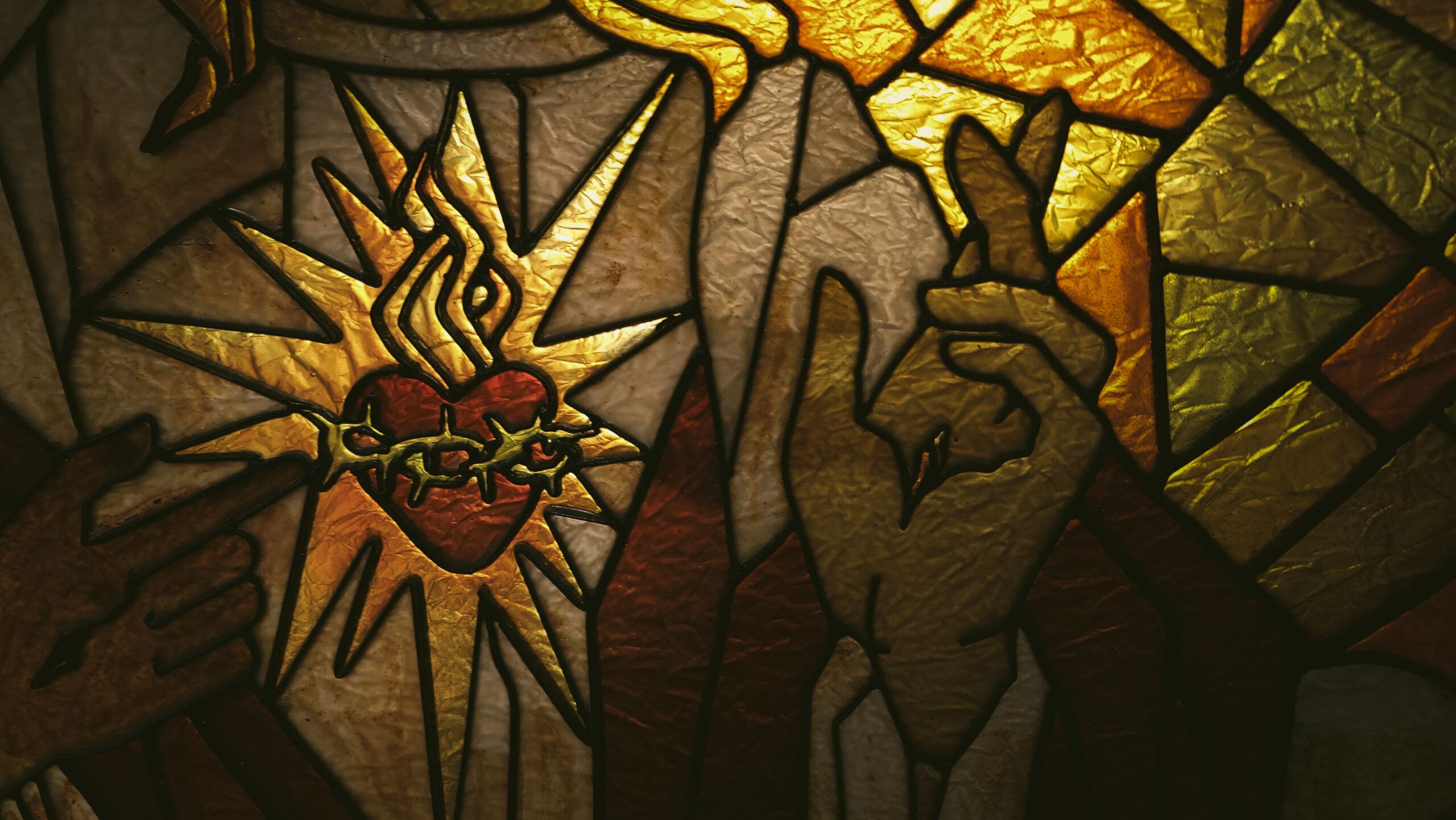
From a young age, despite what I heard adults say about how Catholics were not deeply spiritual but only believed in following rules, I sensed a profound depth to Catholic spirituality. For one thing, I knew that they attended church every week. In fact, they had an obligation to do so, whereas for us Protestants, it was optional. Many of my parents’ friends, however, said that this was not a sign of devotion on the part of Catholics, but rather them just “going through the motions.” However, I remember being captivated by the images in Catholic schools—Christ crucified, and Saints suffering with their eyes wide open. I was particularly fascinated by the image of the Sacred Heart of Jesus, surrounded by a crown of thorns and aflame with passion for our salvation. I watched foreign films, and I noticed Catholic children making the sign of the cross before meals. This struck me as being a very spiritual gesture, an acknowledgement that we are not only flesh, but also souls. It struck me that within our moral bodies we encounter immortality.
When I was in fifth grade, and my older brother was attending a Catholic junior high school, I read his textbook for faith formation class and religious education. What struck me wasn’t just the doctrine it presented, but its emphasis on the importance of having an encounter with Christ. The book gave examples of how we, as children, could bring Christ’s presence into daily life—in the playground, at home, and in the classroom. This was an embodied faith, not just a list of rules, doctrines, or moralisms. It was a faith to be lived and understood, allowing room for mystery.
Television also played a large role in forming my impressions about the Catholic Church. Like many Protestants of my generation, the deepest impressions that were made on me about what it meant to be Catholic came through the highly televised lives of the first Catholic president and his family. The news that priests had administered “the last rites” to John F. Kennedy when he was dying in Dallas introduced us to the sacraments of the Catholic Church, which are mysteries to us Protestants. Something similar was true of Catholic forms of prayer. The image of Senator Robert F. Kennedy clutching rosary beads as he lay dying on the kitchen floor of the Ambassador Hotel introduced me to a prayer of beads and repetition that was at once beautiful. Suddenly, what had once seemed so distant and alien to us became accessible.
For many of us, the practical meaning and application of Catholic thought and teachings to our daily lives were given depth during broadcasts of Bishop Fulton Sheen. Similarly, we were enthralled by coverage of the Second Vatican Council and the grandfatherly image of Pope John XXIII. It became clear to me that the Catholic Church had a civilizing effect on our culture and touched the very depths of our humanity.
By the time I attended Catholic elementary school in the sixth grade, in 1968, I saw the Church as a civilizing force in the city, holding a society together that was at risk of being torn apart by narcissism, hedonism, and violence. While the secular culture promoted the idea that everything pointed toward the greatness of Man, and that Man was “the measure of all meaning,” the spires of the Cathedral, where we attended Mass, pointed beyond the transitory world to infuse our lives with beauty, goodness, and Truth. Conversely, while the secular world saw the future as being bleak and growth of humanity as a type of predatory virus on the earth, the Catholic espoused the dignity of every human person from conception until natural death and had families that were large, welcoming, and gracious. It seemed to me that Catholic families celebrated life while others trembled fearfully embracing a culture of death.
Spiritual Wandering and Return
Nonetheless, as a teenager, I drifted away from Christianity. The elders in the Protestant church I attended discouraged intellectual curiosity and ridiculed questions coming from a precocious teenager that they were unable to answer. I began to see Christianity as being all about conformity and “good behavior.” What I saw in Christianity touched neither my mind nor my soul. Its emphasis was entirely on faith with no room for reason. It offered me simple, one-dimensional “answers” without an invitation to enter into the mystery. I couldn’t imagine how it might be relevant to my life.
It was not until I went to college that I began to take a second look at Christianity and see it as being potentially relevant once again. My girlfriend was a member of a student group of evangelical Christians, and they were at least willing to raise questions about the contemporary world, even if they were unwilling to explore those questions deeply. They challenged the campus culture of weekend binges and casual sex, promoting instead the “old-fashioned” idea of commitment to the sacramental covenant of marriage. Above all, they introduced me to an aspect of Christianity that hadn’t been a part of my upbringing. While the church I grew up in emphasized good behavior and racial equality, these Evangelicals emphasized surrendering one’s life to Christ and walking in the Holy Spirit. This seemed to take the notion of “faith” to a deeper level.
1978 was “the year of the three popes:” Paul VI, John Paul I, and John Paul II. It was also the year I entered full communion with the Catholic Church. The evangelicals had reawakened my curiosity about Christianity, but what they offered me seemed incomplete. I knew from my formative years in the A.M.E. Church and Catholic elementary school that there was more to Christianity than a naive literalist interpretation of the Bible, proof-texting, and street-corner evangelization offered. I decided to visit every church that I had been affiliated with in my childhood to find out what was missing in my new forms of Christian experience. Every Sunday, I visited a different church. One Sunday, I went to a Methodist church, the next Sunday it was a Baptist church, the next Sunday it was a Presbyterian church, until I finally wound up in a Catholic church.
The Catholic church I visited was an architecturally modern building. The name of the parish was Immaculate Conception. I hesitated before entering the church because I knew, from my elementary school days, that there were rituals that one must observe, but I wasn’t sure I could remember what all of them were, and I didn’t want to embarrass myself. I knew enough not to try to receive communion because I wasn’t Catholic. I followed the example of the parishioners and genuflected, bending one knee to the ground, when entering and leaving the pew, which I felt was a profoundly ennobling gesture, although I had not yet learned the gesture was directed toward Jesus in the tabernacle, the housing for the Eucharist located behind the altar. I watched the parishioners and learned to stand when they stood, sit when they sat, and kneel when they knelt.
The Mass I attended was a folk Mass, a style of Catholic liturgy that emerged in the 1960s and 1970s, following the Second Vatican Council. It sought to make the Mass more accessible and relevant by incorporating the musical idioms of contemporary folk and popular music into worship. This was quietly inspiring in ways that caught me off guard. The strum of acoustic guitars created a warm, intimate atmosphere, while the untrained voices of students rose and fell with an unpolished authenticity. Their harmonies weren’t perfect; voices cracked slightly on high notes, some students sang a beat behind, but this very imperfection reminded me that holiness breaks through the ordinary with a surprising, almost startling simplicity.
The liturgy itself felt humble, almost fragile, yet it somehow carried the full weight of centuries, of eternity pressing into that small space. Unlike the forceful and emotive sermons I was used to, the power of this liturgy came through gesture and symbols, the liturgical color of the vestments, the reverent elevation of the host. There was something profound in watching college students in worn jeans and sneakers participate in rituals older than the stones beneath their feet. The priest’s voice was conversational rather than commanding, the bread broken with gentle hands. Yet in that stripped-down vulnerability, the mystery felt accessible and profound. It felt like a bridge between heaven and earth, the sacred and the secular, as if Christ Himself sanctified the everyday. The barriers between the human and the holy were cleared away. It was at once down-to-earth and quietly, powerfully elevating. I felt as though I belonged.
The weeks that followed only deepened this sense of encounter. I found myself returning not out of obligation or even curiosity, but drawn by something I couldn’t name. Each time I knelt before the altar, the same quiet transformation seemed to occur, not dramatic or overwhelming, but steady and real, like watching dawn break slowly over a familiar landscape. If receiving religious instruction so that I could participate in the sacrament, the bread placed on my tongue carried weight beyond its physical substance. This presence lingered long after the taste had faded. I began to notice how the other communicants approached with a reverence that seemed to acknowledge something actually there, not just remembered or symbolized. Their faces held the same mixture of humility and anticipation I felt rising inside of me.
What struck me most was how this presence extended beyond the ritual itself, threading through ordinary moments in the days between services. The memory of that broken bread would surface while I was washing clothes or walking across campus, carrying with it the same sense of sanctuary I’d felt in that small church. It was as if receiving communion had opened a door that had been slightly ajar, allowing glimpses of the sacred to filter into the mundane. The theological arguments I’d once found so abstract – transubstantiation, Real Presence, the mystery of the Incarnation – began to feel less like doctrines to be understood and more like inadequate attempts to describe an experience that defied complete explanation. I was beginning to understand that belief in the Real Presence wasn’t primarily an intellectual position but a response to repeated encounter with something or Someone unmistakably present.
Wrestling with Doubts
This feeling of belonging, however, was not to go unchallenged. First, I would have to wrestle with significant theological and racial concerns. Protestant evangelicals warned that Catholics “prayed to statues,” had “changed the Bible,” and lacked authentic spirituality while Blacks accused the Catholic Church of being “white” and “Eurocentric.” These questions raised doubts. Were Catholics really Christians afterall? If they worshipped Jesus Christ, why did they have so many devotions to the saints and Mary? Was Catholicism truly inclusive or simply a Eurocentric structure that only tolerated non-white presence without embracing it? Was it possible to be a Black American and fully Catholic? The answers to these questions came grudgingly.
As I began to attend Mass on a regular basis, parishioners took the time to explain the sacraments, the liturgy, and Church teachings. Catholic college students, who had grown lukewarm in the faith that had been handed down to them from birth, seemed to be re-energized as they saw their faith through my eyes, as an outsider who wanted to learn more. A priest instructed me on a weekly basis in each chapter of the Catechism, “Life in Christ,” helping me to work through my doubts about the Catholic Faith.
The idea of saints interceding in daily life initially struck me as foreign, even superstitious. But as I spent more time in the parish, I began to notice how naturally the older parishioners spoke of Saint Anthony when they’d lost something, or how a woman would light a candle for Saint Jude when her son was struggling. What might have seemed like magical thinking revealed itself as something more intimate. These weren’t distant theological figures but companions in the everyday struggles of life.
I found myself drawn first to Saint Thomas Aquinas during finals week, not because I believed in some cosmic intervention, but because there was comfort in knowing that someone who had wrestled with doubt and intellectual questions had walked this path before me. When I whispered a quick prayer to him before exams, it felt less like asking for supernatural help and more like acknowledging I wasn’t alone in the struggle to reconcile faith and reason. Gradually, this expanded to other saints—Saint Augustine when I battled with moral failures, Saint Teresa when prayer felt dry and empty.
The breakthrough came when I realized this wasn’t about believing in magical interventions but about entering into the communion of saints that the Creed speaks of. These men and women who had lived, struggled, and died in faith somehow remained present, their experiences and intercessions weaving through the fabric of daily life. It was less about them changing my circumstances and more about them accompanying me through them, their lives serving as both example and encouragement that holiness was possible even in the midst of very human struggles.
The “Marian spirituality” of the Blessed Mother resonated with me, but I felt guilty about being drawn to her because that was something I thought a good Protestant boy should not do. Mary represented qualities that speak to universal spiritual longings, such as unconditional love, comfort in suffering, and intercession during difficult times. She became, for me, a model of faithful surrender to God’s will. Her maternal presence was particularly appealing, offering me nurturing spiritual guidance. The rich tradition of Marian art, music, and literature carried profound beauty that transcended denominational boundaries. Marian hymns like “Ave Maria” and paintings of the Madonna and Child moved me by their spiritual depth and artistic beauty.
Still, I questioned where this was heading. Shouldn’t our emphasis, as Christians, be on Christ as the sole mediator between God and humanity? My friends frowned when they saw me praying the Rosary, saying that praying to or through Mary diminishes Christ’s unique role in our salvation and borders on idolatry. I could only imagine what my mother and father would think if they found out I was praying the Rosary. I felt as though I was betraying the core beliefs of my family and the community. My heart felt drawn to something beautiful and meaningful, while my mind was ringing with alarms. I wondered if my attraction represented spiritual growth or spiritual compromise, authentic devotion or dangerous deviation.
Then there was my struggle with the Church’s European heritage. I was genuinely drawn to Catholicism’s global character—through books and magazines, I could see a faith tradition that spanned continents and cultures. Yet I couldn’t ignore how Catholic imagery, liturgy, and leadership had been predominantly European-centered for centuries. Would embracing this tradition mean accepting a framework that had historically overlooked people who looked like me? My friends raised pointed questions about European colonialism’s use of Christianity as a tool of cultural domination, reminding me of the Church’s complicity in slavery and the suppression of indigenous practices. These concerns weighed heavily on me.
But then I discovered the wealth of literature available in the church narthex—books by Thomas Merton, Dorothy Day, the Church Fathers, and mystics like John of the Cross and Teresa of Avila. This collection exposed me to dimensions of Catholicism I hadn’t known existed, from contemporary writers like Marshall McLuhan and Charles Taylor to ancient texts dating back to the first centuries of the Church. I began to see that Catholicism had a rich intellectual tradition that challenged rather than simply reflected the dominant culture. This was refreshing after encountering anti-intellectualism in some Protestant circles. More importantly, these texts revealed that Christianity was meant to be encountered and embodied, not just believed as abstract ideas. Through my experiences with parishioners and my reading, I was beginning to understand that faith was incarnate and sacramental—lived out around kitchen tables, in supermarket lines, at the bedsides of the sick and dying. Still, one question nagged at me: how would I fit in?
At that time, there were very few people in the American Catholic Church who were not of European descent. Many of my Black American friends pressed me on this, asking, “What are you doing going to that ‘White Church’?” To them, the Catholic Church was Eurocentric, and my plans to convert to Catholicism felt like a rejection of Black American culture, heritage, and the Black community. They told me the Catholic Church would erase my Black identity. I had to struggle with this because, if it came down to that, I didn’t want to break ties with people who had been important in my upbringing.
Universal Belonging
One of the great benefits of my faith formation was meeting Catholics from Africa, Asia, and South America. This exposed me not only to the Church’s diversity, but helped me realize—through these students’ example—that my identity wasn’t merely linked to social categories, but defined by being born in God’s image and baptized into the Body of Christ. A Nigerian student in my dorm, raised Catholic, was living proof that African experiences weren’t incompatible with the Church’s universality.
I began reading about ancient Christian traditions predating European colonialism—Ethiopian Orthodox connections, early African Christianity, how Christianity itself emerged from the Middle East and North Africa, not Europe. I discovered saints from every continent: Northern African Catholics like Augustine of Hippo, Black Catholics like Martin de Porres and Benedict the Moor. The Church’s social justice tradition spoke powerfully, emphasizing universal human dignity and preferential option for the poor.
In the Catholic Church, I found liberation from constraints I’d accepted based on secular cultural identities. The Church didn’t erase who I was; it broadened and transformed me. I was free to embrace humanity’s vast cultural heritage.
In liturgy, I sang hymns by medieval monks alongside African American spirituals, prayed with Spanish mystics and Irish saints, celebrated Ugandan martyrs and German doctors of the Church. It felt like inheritance, not appropriation. Aquinas’s insights, Teresa of Avila’s mysticism, Dorothy Day’s activism—all belonged to me now, just as my cultural gifts belonged to the universal Church.
I moved from secular culture’s limiting categories to discovering myself within something infinitely larger. Where narrow identity markers once confined me, I was invited into two millennia of human experience across every continent. My particular identity gained deeper meaning within this larger narrative. My experience as an African American man connected to all Christian history—from early martyrs to Desert Fathers, from Ethiopian monks to contemporary African cardinals shaping doctrine in Rome.
I was no longer just a young Black man navigating modern America, but part of an unbroken chain of believers who found in Christ both affirmation of their sufferings and promise that suffering wasn’t the final word. I inherited the wisdom of ages, connected to believers across cultures wrestling with meaning, suffering, love, and transcendence. This liberation felt like breathing deeply after years in cramped spaces.
What began as a childhood fascination with crucifixes and foreign liturgies became an unexpected homecoming. The God who called me through beauty had formed me through grace, revealing my spiritual wandering as preparation for this recognition. In embracing the Catholic Church, I discovered conversion as fulfillment, not abandonment—completion of my story within salvation’s eternal narrative. Cultural categories’ narrow confines gave way to universal communion’s expansive embrace.
In the end, the Church found me through her patient work of providence, beauty, and grace. What seemed a departure from Protestant roots became their deepest flowering, as if my ecumenical childhood had prepared me for this moment when my spiritual journey’s scattered pieces finally found their home in the one, holy, catholic, and apostolic Church.
My Priestly Vocation
It has been more than forty years since I entered full communion with the Catholic Church. Although I have had moments of doubt—especially following the sexual abuse scandal and the political polarization that has touched even parish life—I have never regretted that decision. The questions that once seemed like obstacles to faith have become deepening invitations into its mystery.
Nearly forty years after entering the Church, I was ordained as a diocesan priest. Today I serve as administrator for a personal parish for Black Catholics in Pittsburgh, and I spend considerable time in Catholic schools where many Protestant African American students are discovering, as I once did, that faith need not be confined to narrow cultural or racial boxes. I don’t seek to diminish their traditions, but I want them to have the same opportunity I had, to encounter a faith expansive enough to embrace the full complexity of human experience and identity.
The same tensions that shaped my own journey toward Rome continue to shape the Church today. Liturgical divisions between traditional and contemporary worship threaten unity rather than celebrating our catholicity. Social media offers unprecedented access to quality catechesis while undermining the face-to-face community that remains essential to sacramental life. Yet these challenges remind me why the incarnational character of our faith matters so deeply. In a world of increasing abstraction and virtual connection, Catholicism insists that grace comes through material reality through bread and wine, through human community, through the messiness of institutional life.
As a priest, I have dedicated my ministry to making this incarnational faith accessible, particularly in what often feels like spiritual deserts. Whether through Catholic education, evangelization that honors cultural diversity, or social teaching that refuses to separate moral theology from lived experience, the goal remains the same: to help others discover what I found in that small college parish decades ago, that the sacred doesn’t abandon the ordinary but transforms it from within. The journey that began with a restless undergraduate’s questions has become a lifetime of accompanying others as they discover that Christianity, at its best, doesn’t diminish our humanity but reveals its deepest possibilities.