A ‘Nothing’ Surrounded by Religion
Whenever I talk about being a convert to the Catholic Faith, people always ask: what was I before? I always have to say: well, I was nothing. Though both of my parents had interesting religious histories themselves, they didn’t raise me and my two brothers with any practice or affiliation.
My father, as far as I have been able to learn, grew up associated with Unitarians. However, at some point during the 1960s, he converted to Judaism. My mother says it was for a woman he had hoped to marry, but it must have been more than that, because when I was small, I remember how once in a while he would go to the front windows around sundown and say prayers from a little book. Similarly, I remember him lighting the menorah around Christmas time. These seemed, however, to be personal, private things, and no explanation was given for them.
My mother grew up in the Methodist church and was active, as far as I could tell, even serving as an organist. However, she says that she drifted away from faith and practice during college.
Even though my family didn’t seem to have any religion, there was a lot of religion in the neighborhood. The rector of one of the Episcopal churches in town was our neighbor on one side, together with his wife and their dog, Nicodemus. On the other side, the neighbors were Baptists, and the grandparents living there had been missionaries in China. I also had friends whom I knew were Jewish. When I got a little older and worked as a paperboy, one of my neighborhood delivery addresses was “Dominican Sisters.” I didn’t give much thought to what that might have meant, and I never met them, because they paid by mail. But even now, I think sometimes about how, through all the folly and confusion of growing up, they were merely a couple of blocks away, praying.
I don’t know whether it was the prayers of any of these people, their example, or what, but in any case, it was sheer grace that from an early age I felt an attraction to and fascination with the Lord Jesus and his Passion. When movies about Jesus came on around the holidays, I always wanted to watch.
My parents did try to help me somewhat with these childhood wonderings about religion and faith. I knew that certain folks were this or that kind of Christian, or that others were Jewish, but what was I? I remember my mother taking me to a couple of different Protestant services in the neighborhood, but I guess none of them stuck. My father took me to a local Hebrew school session once or twice, but apparently he didn’t approve of it himself, so that was that. In the end, when I asked “what I was” in terms of religion, my parents told me that this was a decision I could make on my own when I grew up. That said, they were somewhat surprised when I did exactly that!
When we were twelve, my best friend down the street went through a phase of religious fervor and wanted to take me to church with him. I was grateful and interested. Mostly, I remember what must have been a small group for boys during the service, a significant part of which, as I recall, was memorizing the order of the books of the New Testament and drills on who could find a particular chapter and verse first. I also remember the minister in charge giving an explanation and illustration of what St. Paul was trying to say about meat sacrificed to idols in 1 Corinthians, and it was so good that I have continued to borrow it to this day.
It was around this time that I asked for a Bible for Christmas. I still have it. It’s a New King James translation, inscribed to me on the “Presented to” page, “from Mom & Dad, Christmas 1984.”
Providence for a Drifter
Twelve-year-olds turn into teenagers, however, and as a teen, I drifted away from these considerations. I was into video games, my little circle of friends, and especially music. I discovered heavy metal and punk rock, and soon fell into the uniforms and sentiments of those subcultures. But even in this, as has become clear to me over the years, God’s Providence and guidance were preparing me for my call into his Church and the consecrated life.
My time as a heavy metal and punk rock kid showed me that the ordinary thing, the usual thing, wasn’t what you really wanted. For example, the radio stations in the middle of the dial played music, and that was fine, but for the music that was truly exciting, that would really speak to me, I had to discover the college radio stations at the far end of the dial. Even the physical geography of being into this music spoke to seeking a way apart from the beaten path. The stores that had the records I wanted were on the second floors of buildings; the bands played in basements. In all of this, I believe the Holy Spirit was working and preparing in me the insight and desire to look for something different, an alternative way of thinking, and even life decisions that would be, perhaps, unthinkable within the secular, liberal worldview I had absorbed growing up.
As I got older, towards the end of high school and thinking about college, the gentle movements of providence began to guide me in other ways as well, although consciously I had more or less forgotten about the religious concerns of my younger self.
As a child, arithmetic was always my worst subject. I’m still not to be trusted with it. This all changed when I arrived at calculus toward the end of high school. There was a beauty about it, a sort of invitation to wonder at the ordered universe. In a way, I fell in love with mathematics a little bit. When I went off to college, I even had the idea that I might major in math and took a couple of courses my first year. It never happened, though, because I moved on to my next discovery – philosophy.
As a senior in high school, I participated in a program that allowed me to take a class at a local university. I don’t remember how, but I chose a course in Plato’s Republic. I can’t say I did very well. One time, a short paper I had tried to write was returned with only the comment, “Please try again.” Nevertheless, my mind was opened to a world I had not known before. Here was someone trying to make sense of the beauty and order of the cosmos that I had glimpsed in my enjoyment of mathematics. I was hooked. I went to college and declared a major in philosophy.
Perhaps ironically, studying philosophy in college began to reawaken my earlier religious concerns. I remember taking Philosophy 101 as a freshman. One of the units in the course was on “the meaning of life”. After various readings and group discussions, the class decided, with the assent of the professor, that there was no such thing as the meaning of life, but that one could still seek “meanings in life”.
I was disappointed. Surely, given the ordered and beautiful cosmos that I had begun to notice in mathematics and had heard about from Plato, there should be some kind of ultimate meaning applicable to all things and all of our lives. Apparently, philosophy could only take me so far.
Prayer at an Impasse
With all of these reflections and considerations and more swirling around in my mind, I went home for summer vacation after my freshman year of college. Early on, one warm night, I experienced another moment of sheer grace.
I picked up the Bible I had been given for Christmas seven years earlier, opened it to the New Testament, and read the first thing I found—the Gospel according to St. Matthew. I read it straight through. It resonated. Here was the thing—the Good News of Jesus Christ. This was what made sense of the awe and wonder that I had experienced in glimpses of a beautiful and ordered cosmos; here I found the meaning that philosophy pointed to but fell short of grasping. That was it. That night I made the decision: I was going to become a Christian.
But how? There were so many kinds and denominations of Christians. What did all of these differences mean? Which should I approach? Which church was “right”?
I started reading what I could about Christianity and Church history, about how the diversity of churches and ecclesial communities came to be. I visited different churches, too, and attended some services. A high school acquaintance had introduced me to the local Quaker meeting, and I went there on a few Sundays. Although I didn’t know anything about prayer at the time, and still less about contemplation, the quiet, receptive nature of the worship there attracted me.
It was in this mode that I returned to college for my sophomore year, thinking that if I were to simply read and learn more about the different denominations and kinds of Christians, I would eventually be able to see which church was “right” and which one I should join. It didn’t work. In fact, as I continued to read and learn, I only felt more lost. Ever more options emerged. On their own terms, each denomination had an argument for being the “right” one.
I felt stuck. I knew I wanted to be a Christian, but I couldn’t figure out what kind to be, which church to approach. This impasse soon became another of the pivotal graces of my conversion. I didn’t know what to do, and this frustration pushed me, for the first time, to prayer.
Until this time, the journey was all in my head. Yes, I had come to believe in God, but it had not occurred to me to relate to Him in any personal way. My idea was to reflect as best I could, decide on the path that made the most sense, and then follow it to its logical conclusion. Now this approach was failing me, and I had the grace of somehow deciding to turn to God himself to ask Him what I should do.
So, I started to pray the best way I could imagine doing such a thing. I tried to address God and to present Him with my reflections and the desire of my heart, unaware at the time that it was His grace that had planted and cultivated these desires within me in the first place.
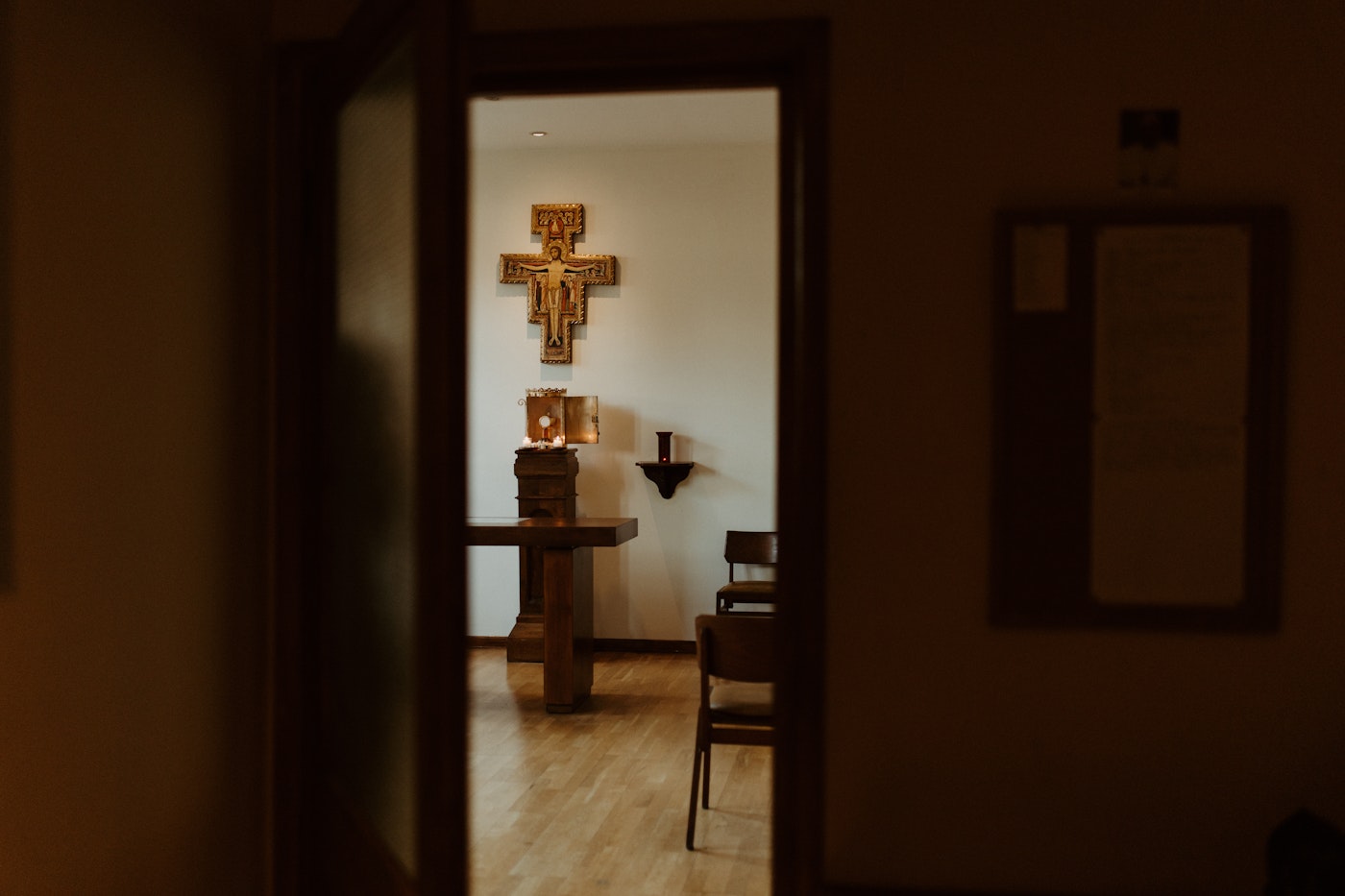
There was a chapel on campus. It was dim, quiet, comfortable, and empty most of the time. I began to go there to pray, to ask God to show me what sort of Christian I should become.
Once I started to pray like this, my confusion began to clear up, although not in a way that was comfortable at first. As I continued to read and reflect on Christianity and its history, I started to notice that I was internalizing it in a Catholic way. It wasn’t exactly that Catholicism was “right,” but that the Catholic sensibility of things just made sense of everything in a way that was a coherent whole. In other words, the Catholic Faith seemed to make the different elements of Christianity come together in a way that made sense: apostolicity and apostolic succession, the Bible, authority, and especially the sacraments. I began to experience a desire to know God in Jesus Christ through a sacramental life.
I was also intrigued by certain things I observed when I visited Catholic churches, especially people praying. Was there more to prayer than the simple request for guidance I had been making? What about the images and statues of saints? Who were all these different people? I examined the little cards that were sometimes available and the prayers for different purposes written on them. What was “contrition”? I didn’t even know the word! What did it mean to make an “act” of faith or hope? These questions drew me in. I was curious—I felt like there was something there that I needed and wanted.
At first, this realization that I was being drawn to the Catholic Faith was a challenging surprise. The Catholic Church? Isn’t the Catholic Church backward on things like sexuality and abortion? Aren’t the priests repressed and strange? I had grown up with and always taken for granted the secular, liberal ideas about these things. It made me uneasy to imagine thinking differently.
Further, what would people think? Would my friends think anything of it if I were to become a Catholic? (I didn’t think about my parents, because I didn’t intend to tell them, but when they did find out, it was not an easy thing.) At the time, I had a girlfriend who was Jewish, and I hadn’t shared much of this religious journey with her. I was very fond of her and worried about what might happen to our relationship if I were to become a Catholic.
I struggled. Surely there were other kinds of Christianity I could embrace that would mean less of a departure from what I had been taught and had always considered the correct way to think about things — especially sexuality and abortion. I had even found the local Quaker meeting and had visited a couple of times on a Sunday. I remained drawn to that sort of worship. Why not stick with that?
I went back and forth with this struggle for a time. Eventually, however, my conscience overcame my anxieties. I had asked God for guidance and direction, and it seemed that my prayer had been answered. If God wanted me to become a Catholic, how could I reject the invitation? I couldn’t begin my journey as a Christian that way, dismissing the first answer to prayer I had ever consciously known. I had to do it; that was it. I would become a Catholic Christian.
Tolle, Lege — Take and Read
The Catholic chaplain was a priest who visited the campus two afternoons a week, on Wednesdays and Saturdays. On Saturday he offered the vigil Mass for Sunday at the chapel. His main chaplaincy was a larger university in the area.
I went to see him for the first time in the middle of the fall semester of my sophomore year. I explained that I wanted to become a Catholic. His response rather surprised me. I thought he would be happy to hear such a thing and sign me up right away. Doesn’t the Catholic Church want people? Instead, he was rather matter-of-fact about my request and invited me to read a book and then come back if I wanted to talk to him again. The book was Fr. Thomas Bokenkotter’s A Concise History of the Catholic Church.
I borrowed the book from the library, read it, and went to see the priest again a couple of weeks later. I said that I had read the book and asked if he could now tell me how to become a Catholic. Once again, he did no such thing. Instead, he gave me the title of another book with the same instructions: read it, and if I wanted, I could come back again. This book was Fr. Richard McBrien’s Catholicism. (I now know that there are issues with this text and do not recommend it.) Again, I went to the library, but when I saw the book, I became a little frustrated. It was big — two volumes! I had to read this whole thing in addition to all of the study I had to do for my classes?
I calmed down and God strengthened me with the same reflection that moved me to go to the priest in the first place. If this invitation was from God, I had to follow it. I needed to trust the priest and be patient. I borrowed the books, got through them, and eventually went back to the priest. Surely, after all this reading he would tell me how to become a Catholic.
Not yet. Again I was told to go read a book and come back. And so it went on, well into the spring semester. I began to get tired of this and frustrated, but in retrospect I can see the wisdom of the priest’s pastoral approach. I was nineteen years old and wanted everything to happen quickly. By inviting me to read, the chaplain was not only making me take my time with a decision, but helping me to further educate myself, to get to know what I was asking.
It Looks Like a Pizza Hut
As the spring semester of my sophomore year wore on, I decided to tell the priest I didn’t want to read any more books. I just wanted to become a Catholic and wanted him to tell me how. I wasn’t sure if it was a good idea to speak to a priest in such an assertive way, but I had grown weary of him saying the same thing each time I went to see him.
So I did it. I told the priest I wanted to be finished with book assignments, and would he please tell me how to become a Catholic. To my surprise, he relented immediately. Perhaps I had passed a test, or maybe he had been waiting to see something in my desire and resolve, and that day he did.
It wasn’t something that could be done on campus, he explained. I needed to go to a parish church. I didn’t know what that was, so he explained to me the nature of parishes. There was one nearby, Father explained, and I could go there. He told me how to introduce myself and to whom, and gave me directions. I was to go out the Williams St. gate, turn right, walk about a mile, and the church would be on my right: Our Lady of Perpetual Help. I couldn’t miss it—it looked like a Pizza Hut!
I thanked the chaplain profusely. Finally, he seemed to be responding to my eager interest. I went to the library to look in a phone book for the church’s number. It didn’t occur to me that one might ask for an appointment. I would just go to a service. Fortunately, or providentially, there was an evening Mass that very week. It was the vigil for the Solemnity of the Ascension. I went early. The church was right where Father said it would be, on the right, across a parking lot, and indeed, looked something like a Pizza Hut. The sacristy was in the back, near the entrance, and I saw the pastor there.
I walked in, and introduced myself, letting him know I was Charles, a student at the college, that wanted to become a Catholic, had been talking to our chaplain, and that he had sent me. The pastor was friendly and seemed like a gentle person. He introduced me to the deacon, who was in charge of “convert instructions.”
Convert instructions turned out to consist of Thursday evenings at the deacon’s house. There were three of us to be “instructed”: myself and two people who were coming into full communion on the way to marrying a Catholic. The intended spouses attended the sessions as well, to make five of us altogether. We watched catechetical videos, the deacon taught on different topics, and we had discussions. It was informal and friendly. The deacon’s wife provided light-hearted commentary and snacks. One of the couples would pick me up from campus and bring me to the deacon’s house. When I was baptized, they served as my sponsors. I got a summer job in the college library so I could stay on campus over the break and attend my convert instructions.
Yes, I know what you’re thinking. What about RCIA, the restored catechumenate? I don’t know. I guess they hadn’t heard of it in this parish. I laugh because, knowing my future Catholic self, I certainly would have insisted on the formality of the full RCIA had I known about it!
In the course of the convert instruction sessions, I asked about a timeline. When could I be baptized? The deacon replied that we would think about it along the way, in conversation with the pastor. The summer wore on. I wondered if I could conclude the process and be baptized before classes began. I asked, and the deacon seemed to like the idea. A date was set. It would be the last Saturday in August, before everyone came back for the fall semester. I was informed, however, that I would have to be examined by the pastor. This would happen the day before, after the morning Mass.
I was nervous and spent the evening before the examination trying to review everything. The persons of the Blessed Trinity, the Apostles’ Creed, the Sacraments, the virtues, the gifts and fruits of the Holy Spirit.
After the morning Mass, the pastor invited me into the rectory and had me sit at the kitchen table. He gave me a piece of toast and a cup of coffee. Then he sat down and asked me if I was ready to do this, to be baptized and become a Catholic. I said yes, very much so.
That was the examination. He gave me a signed and sealed certificate for the baptism to take place the next day, I finished my coffee, and was shown out. The deacon and his wife were waiting outside to ask about the “examination.” I told them it was easy. They asked me if I had been offered coffee and whether it had been good. I said yes, but no, it wasn’t very good. The deacon warned me, as a final lesson in my convert instructions, that this would often be the case in the Catholic Church. Don’t expect good coffee.
Around midday on Saturday, I put on my tie and walked down to the church. Everyone from the convert instructions group was there.
After the deacon baptized me, while I was straightening up from leaning over the font, I heard him say, quietly but audibly,
“Beautiful.”
That has always stayed with me, I think, because I could understand, even somewhat at the time, that he wasn’t exactly saying that it was beautiful that this random kid had been baptized, but that in baptizing someone, he was able to see through that visible sign to divine beauty. That is to say, in theological terms, that a sacrament had happened.
I was very happy. I was now a Christian and a Catholic. After some further pictures were taken, I asked the deacon about my next step. When could I receive my first Holy Communion? He thought for a moment and said it would happen the next day at Sunday Mass.
It was the twenty-second Sunday in Ordinary Time. After the usual communion procession, the pastor introduced me. I was a student at the college, had been baptized the day before, and now I would receive my first Holy Communion.
As I walked down the aisle, the pastor descended from the sanctuary with the paten. He put into my hand a half of his priest’s host, which felt like an almost overwhelming privilege at that moment. It was one of those hosts embossed with an image of a crucifix and other symbols of Jesus’ Sacrifice. As I returned to my place, praying with awe and thanksgiving, I felt a sense of having come full circle from my first curiosities about the Lord and his Passion when I was little.
After many wonderful congratulations, again I asked about my next step. When could I be confirmed? The deacon thought again, and declared that I needed no further instructions, but that I could simply show up on the assigned evening in December with the next group of young people. This I did, and became that night a fully initiated Catholic.
Since then, my Catholic life has been a marvelous adventure, not always easy but ever full of grace and blessing. I graduated from college in 1994 and immediately entered religious life with the Franciscans (O.F.M.) in New York. Feeling like things had moved too quickly and needing more time to discern, I left after the first half of the novitiate year. I then worked in human services for a few years before entering the Capuchin Franciscans (O.F.M. Cap.) in 2000. As a Capuchin friar, I have had opportunities to study and to live in diverse settings, including Costa Rica, Honduras, and Rome for several years. Since September 2023, I have been serving as parochial vicar at our parish in Yonkers, New York.