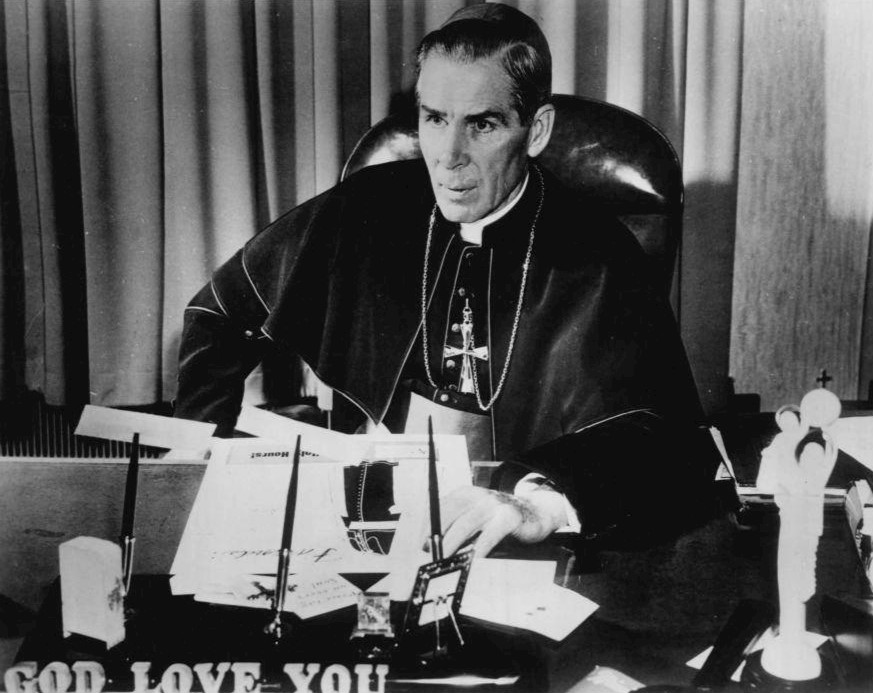
On September 24th of this year, the Catholic Church in the United States of America celebrated an extraordinary moment, as Cardinal Luis Tagle traveled from Rome to St. Louis to preside at the official beatification of Archbishop Fulton Sheen.
When his sainthood cause was opened by the Diocese of Peoria in 2002, Sheen received the title “Servant of God.” After extended research into his life and writings, the Vatican recognized his heroic virtue, and so from 2012 until this September, he was known as Venerable Fulton Sheen. In the intervening years, investigation of a possible miracle involving the healing of a stillborn child resulted in Sheen being officially elevated to the next stage of the sainthood process, known as beatification; he is now recognized in the Church as Blessed Fulton J. Sheen.
In the days surrounding Sheen’s beatification, I had the extraordinary opportunity to interview a number of people who have been deeply affected by his teaching and personal witness through the years, including several who have been directly connected with his sainthood cause. In the course of those conversations, one comment stood out, from a man whose parents had once had Sheen over for dinner. As he put it, even in a house full of people socializing, when you talked to Bishop Sheen, “you felt like you were the only person in the room.”
That particular description of Sheen struck me, because I’ve heard that same kind of comment about at least two other towering figures in 20th century Catholicism. A priest friend of mine once described his encounter with Pope St. John Paul II in the same terms, and I’ve talked to a few people who told me separately that when they met Mother Teresa, whether at a gala or in the midst of her busy mission, they, too, felt like “the only person in the room.”
How is it that these three figures—an Emmy-winning bishop, the most visible and well-traveled pope in history, and a Nobel Prize-winning religious sister—were able to be so present to the people directly in front of them? And was that just an interesting feature of their personalities, or was it an inherent part of what made them saints?
In the Catechism of the Catholic Church, we read that by revealing Himself to Moses as “I AM,” God is revealing not only His being, but also the fact that He is eternally present; “am” is a present tense state of being verb. As the Catechism puts it, by describing Himself to Moses in this way, God “reveals Himself as the God who is always there, present to His people in order to save them.” (CCC 207) Essentially, to be fully present to someone is, in some small measure, to imitate God.
So what does this mean for those of us who want to know how to best share the truth, beauty, and goodness of our Catholic Faith with those who are not yet with us at the Lord’s table?
Maybe the easiest way to frame it is to subvert a common question we get from our members. Often, Catholics who are part of our CHNetwork family will call or write, and share the story of a loved one they’ve been praying for and want to see come home to the Catholic Faith. And often, in those conversations, they will ask us what book they can give that person, or what episode of The Journey Home they should send them.
And while the resources we put together are helpful (we hope!), no book or video or airtight apologetic can replace the real, incarnational, human work of patiently loving people and being present to them. Pope Paul VI once said, “Modern man listens more willingly to witnesses than to teachers, and if he does listen to teachers, it is because they are witnesses.” Arguments and debates and research have their place; most of us had to do a lot of intellectual wrestling on our way into the Church! But it would be a mistake to underestimate the witnessing power of simply being truly present to someone who is seeking truth.
Numerous people were affected by the television and radio teachings of Bl. Fulton Sheen, some to the point of making the decision to explore and enter the Catholic Church. But each of those people still had to encounter someone at the local parish to disciple them, and a local pastor to give them the sacraments. And some of the best stories about the seekers Sheen helped into the Church are the ones about the people he met with privately and personally discipled.
That is why, for me, some of the most rewarding work we do at the Coming Home Network is in the hidden ministry of Pastoral Care, where an inquirer who is at a difficult stage in their journey can connect directly with someone like Ken Hensley, Jim Anderson, Melissa Slagle, or someone else from our staff or CHNetwork community who can address their concerns privately and with the attention they deserve. Each new person who reaches out to us provides us with a fresh opportunity to take up the challenge of Fulton Sheen, of John Paul II, and of Mother Teresa; to treat yet another soul on the journey as the only person in the room.
Bl. Fulton Sheen, pray for us!