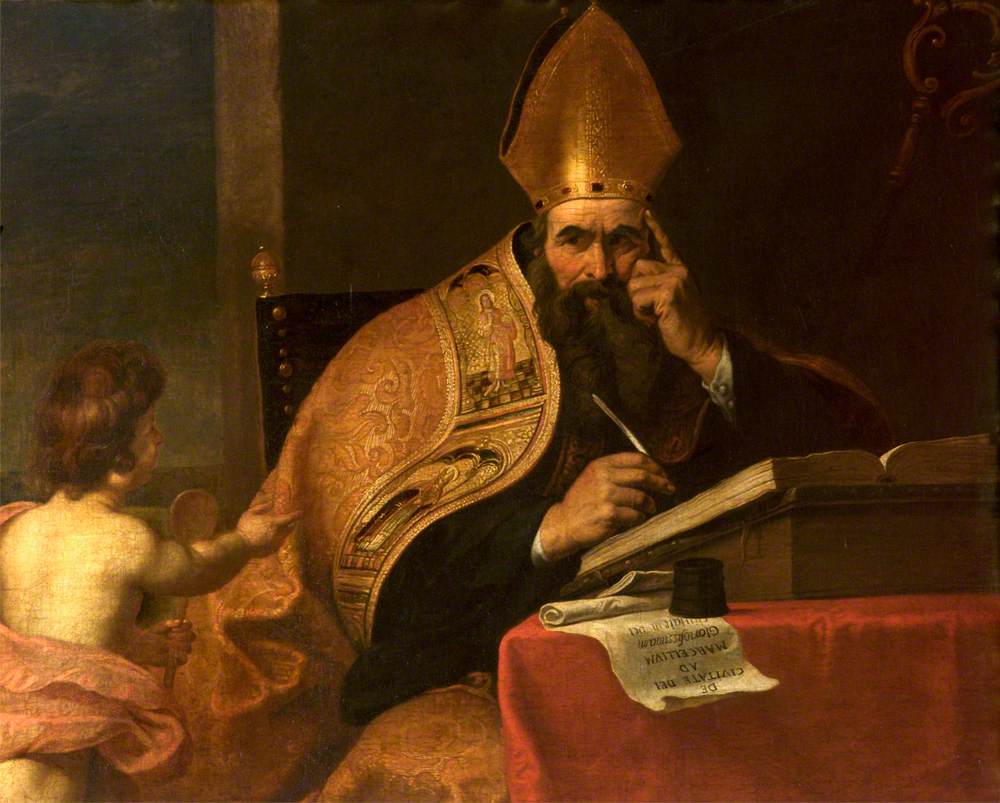
It is well known that many Protestants, especially Calvinists and Lutherans, highly revere St. Augustine of Hippo. John Calvin called him the most orthodox and biblical of the early Church Fathers. He used St. Augustine’s teaching on grace and original sin as proof texts to bolster his personal interpretations on those doctrines. In order to do so, Calvin and many other Protestants have been forced to cherry pick from his multi-volumed writings, choosing teachings they believe endorse their new teachings, while ignoring the fact that Augustine was a champion of orthodox Catholic doctrine. Below you will find a small sampling of the writings of this Doctor of the Church’s witness to ancient orthodox Catholic teachings handed down to us from the Apostles.
On Baptism
“The sacrament of baptism is undoubtedly the sacrament of regeneration.” (The Merits and the Forgiveness of Sin 2:27:43, AD 412)
“Baptism therefore, washes away indeed all sins – absolutely all sins, whether in deeds or words or thoughts, whether original or added, whether committed in ignorance or allowed in knowledge.” (Against Two Letters of the Pelagians 3:5, AD 420)
“The custom of Mother Church in baptizing infants is certainly not to be scorned, nor is it to be regarded in any way as superfluous, nor is it to be believed is anything but apostolic.” (Literal Interpretation of Genesis 10:23, AD 408)
On the Eucharist
The Real Presence: “The bread you see on the altar, having been sanctified by the word of God, is the body of Christ. The chalice, or rather what is in the chalice, having been sanctified by the word of God, is the blood of Christ.” (Sermons 227, AD 411)
“What you see is the bread and the chalice; that is what your own eyes report to you. But your faith obliges you to accept that the bread is the body of Christ and the chalice is the blood of Christ.” (Sermons 272, AD 411)
The Sacrifice of the Mass: “Was not Christ once for all offered up in his own person as a sacrifice? And yet, is he not likewise offered up in the sacrament as a sacrifice, not only in the special solemnities of Easter, but also daily among our congregations; so that the man who, being questioned, answers that he is offered as a sacrifice in that ordinance, declares what is strictly true.” (Letters 98:9, AD 408)
On the Blessed Virgin Mary
Perpetual Virginity: “Thus Christ, by being born of a virgin who, before she knew who was to be born of her, had determined to continue a virgin, chose to approve, rather than to command, holy virginity. And thus, even in the female herself, in whom he took the form of a servant, he willed that virginity should be free.” (Holy Virginity 4:4, AD 401)
Mary Being Without Sin: We must except the holy Virgin Mary, concerning whom I wish to raise no question when it touches the subject of sins, out of honor to the Lord; for whom we know what abundance of grace for overcoming of sin in every particular was conferred upon her who had the merit to conceive and bear him who undoubtedly had no sin. (Nature and Grace 36:42, AD 415)
On the Intercession of the Saints
“It is true that Christians pay religious honor to the memory of the martyrs, both to excite us to imitate them, and to obtain a share of the merits and the assistance of their prayers.” (Reply to Faustus the Manichean 20:21, AD 400)
“This it was that the blessed martyrs did in their burning love; and if we celebrate their memories not in an empty form, and in the banquet at which they are filled to the full, approach the table of the Lord, we must, as they did, also be making similar preparations. For on these very grounds we do not commemorate them at the table in the same way, as we do others who now rest in peace, by praying for them, but rather that they should pray for us, that we may walk in their footsteps. (Tractates on John 84:1, AD 416-17)
On Purgatory
“Temporary punishments are suffered by some in this life only, by others after death, by others both now and then; but all of them before the last and strictest judgment. But of those who suffer temporary judgment after death, all are not doomed to those everlasting pains that are to follow that judgment; for to some, as we have already said, what is not remitted in this world is remitted in the next, that is, they are not punished with the eternal punishment of the world to come.” (City of God 21:14, AD 419)
On Papal Authority
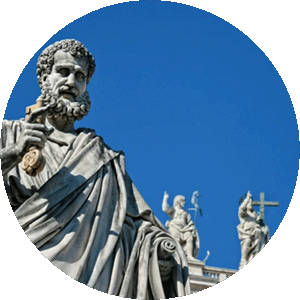
“There are many things that keep me in her [the Church’s] bosom. The consent of the peoples and nations keeps me in the Church; so does her authority, inaugurated by miracles, nourished by hope, enlarged by love, established by age. The succession of the priests keeps me, beginning from the very seat of the apostle Peter, to whom the Lord, after his resurrection, put in charge of feeding his sheep, down to the present episcopate [of Pope Siricius].” (Against the Letter of Mani Called “The Foundation” 4:5, AD 397)
*****
Keep in mind that this is but a small sampling of writings by St. Augustine of Hippo, who is most truly a Doctor of the Church. While a narrow excerpt might seem to lend weight to thought that developed through the Reformation, it is clear that the whole of Augustine’s preaching and writing gives ample witness to a thorough and complete adherence to the one, holy, catholic and apostolic Church.