In my freshman year of Catholic high school, I was elected Pope in a mock papal conclave in my theology class. I was passionate about my faith, loved praise and worship music, and served as a lector and an altar boy. I was not set up to be the kind of cradle Catholic that walked away, but that didn’t stop me from turning my back on the Church. As I drifted further, I thought that my objections and concerns were clever criticisms of Church teaching, but they were mere justifications for my sinful life. The truth is, I didn’t want to be Catholic because being Catholic meant dying to self. That is the rhythm of Catholic life, but it is a rhythm discordant to those whose attention is always inward. Before I could come back to Christ, I would need to be led out of myself. Sacred music would become the instrument for that very thing.
When I rediscovered my faith, I didn’t simply revert back to Catholicism; I was summoned. My study of philosophy, theology, history, and sociology prepared the path for me, but it was music that carried me to confession and the communion rail. It wasn’t just any song though; it was the rarely sung fourth verse of John L. Bell’s “The Summons” that was played at my grandmother’s funeral. It goes like this:
Will you love the “you” you hide if I but call your name?
Will you quell the fear inside and never be the same?
Will you use the faith you’ve found, to reshape the world around,
Through my sight and touch and sound in you, and you in me?
When I sang those first two lines, I was filled with the unsettling realization that God was speaking to me. I felt he was directly asking me, “John, if I summon you to love your hidden self, will you do that for Me?” With that question, the veil in the temple of my heart was torn and, peeking from behind it, I could see my “hidden self” so clearly. My first thought was that he was so small…
The hidden self is not the morass of dark secrets and sins that people like to imagine. The best way I can describe the hidden self is to say it’s an amalgamation of all the times you needed help, but it didn’t come. It is the you that got lost in the mall when you were a small child. It is the you that shared your deepest fear with a loved one, only for them to tell you that it was stupid. It is the you that pretends to be self-sufficient in all things, but can’t ask for help because it’s too shameful. It’s a smaller, younger version of your adult self. Mine peered back with gray blue eyes, mouth twisted in a grimace as if he was in pain—or was he just scared? It is hard to tell what your hidden self is feeling precisely because you hide it.
Looking at him, I realized I could no longer pretend that loving myself meant lying to myself about who I was called to be. I would have to forgive friends who had used me, girlfriends who broke my heart, and teachers who led me astray. I realized that, if I answered this call, my life might bear little resemblance to the one that I had crafted without God. I was terrified. I recognized that God was not asking me for an hour on Sunday, he was asking for all of me. That was too much for me to give in the moment, so I decided to table these thoughts until a later date.
For the next few months, I listened to “The Summons” on repeat. I would not be surprised if I listened to that song for over an hour every day during that time. Each time I played it, I focused on the fourth verse. I contemplated the questions in my heart and wondered, “Is today the day I will answer the summons?” My answer was always, “Maybe tomorrow.”
Reversion meant finally accepting responsibility for loving myself. It would change how I thought of myself, my family, my friends, even my students and co-workers. This was a call to the adventure of a lifetime. Can we ever really be ready for such a call?
Reversion is not like retracing your path using pebbles. It is more like trying to follow a breadcrumb trail after the birds have swooped in to eat. Like Hansel and Gretel, you cannot make your way back home based on your own knowledge, but only by the influx of grace. In the end, it was a bird that led the children back to their home. Likewise, the Holy Spirit leads the revert to the Church by an unknown and uncharted road. It is easy to see after the fact that you were being led home, but when you are lost in the moral wilderness of modern life, your destination feels far from certain.
I would describe my reversion as akin to waking up at the bottom of a snow-covered canyon, hemmed in by wolves, with no way out. Were these wolves the hounds of heaven or hellhounds? I could not be sure. I was certain this encounter would mark the rest of my earthly life and my life in the next. Thankfully, there were no actual wolves involved, just a sheep in wolf’s clothing.
My wife at the time had been an outspoken critic of Catholicism, she was very good at identifying where Catholics were falling short of expectations. Surprisingly, one day, she came home from work and told me about the strange dream she had the night before. In the dream, God told her that she should ask me if I wanted to come back to the Catholic Church. When she told me this, rivulets of tears traced my cheeks, and I confessed that I wanted to come back. One of the major obstacles to my reversion had been her opinion of me and of the faith. Her question in this moment was an invitation to finally answer the summons that had been ringing in my soul for the past three months. Oh, what a relief it was to say it out loud! The tempest in my soul quieted immediately, but the adventure was just beginning.
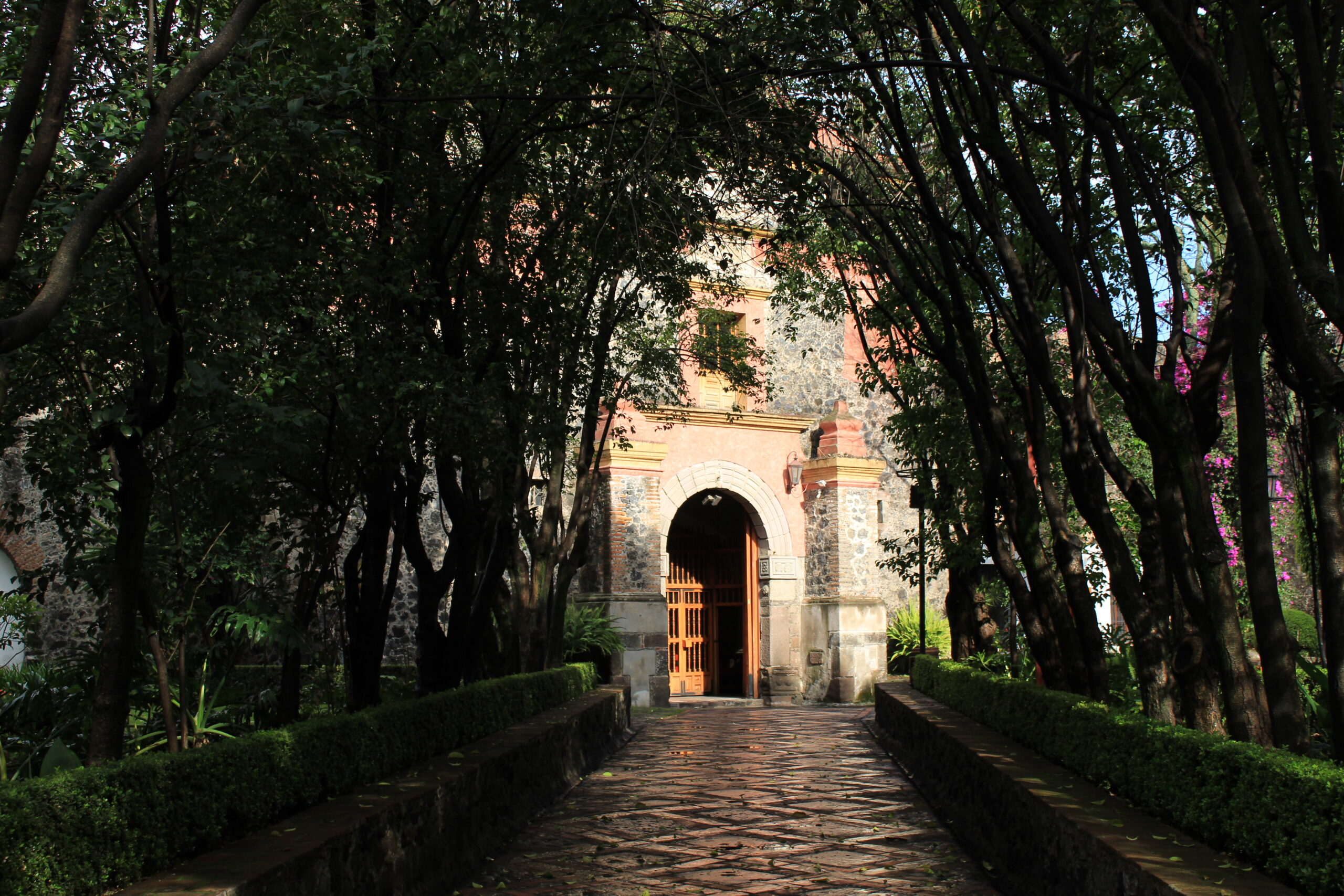
A short time after this conversation, I called a parish near my work and scheduled a confession with one of the priests. I had a profound experience of the sacred at this particular parish, which is why I chose it specifically for my formal step back into communion with the Church. You could see this church from the highway, so high was the cross on its steeple. Several years prior, I had driven there thinking it was a Russian Orthodox church. Having never been to one, I set off to go check it out. When I passed the sign that said “Catholic Church,” I was beyond disappointed, but since I had gone out of my way to drive there, I decided to go inside anyway. As I passed through the giant red double doors, the smell of incense immediately filled my nostrils. The church was elaborately decorated with beautiful stained-glass windows and dozens of statues. The ceiling was midnight blue with gold accents, and the vast majority of the walls were painted a brilliant red. I was flabbergasted; I had never seen such a vibrant and beautiful church. The air seemed to almost hum with unspent energy. In that moment, the sacred shifted from a concept to the concrete. I wish I could say that this experience pushed me to immediately return to Catholicism, but that wasn’t the case. When I did return, I recognized that my experience at that church had paved the way. My first confession in ten years was long, very long. It was also immensely freeing. I felt like I could breathe for the first time in a decade.
A few weeks later, I shared the news of my return with my family. My mom was overjoyed. She shared that my recently deceased Grandmother had known that I had lapsed from the Church. My grandma never talked to me about it. Looking back, I cannot detect any difference in the way she talked to me or treated me. She would not get in the way of God pursuing me for Himself.
Even more shocking, the priest who said my grandmother’s funeral Mass had a special intention in mind. He prayed that my grandma would intercede on my behalf, and that I would return to full communion with the Church. At these two revelations, my eyes swelled with tears. As a kid, listening to the tale of the prodigal son, I always identified with the dutiful son. As an adult, I realized, to my horror, that I had been the prodigal son all along. I felt like my family had been so disappointed in me when they were just worried about me. I would give them plenty more to worry about in the months to come.
Over the next few years, my marriage fell apart, partly because of our religious differences, which were becoming more acute as I journeyed deeper into the heart of Catholicism. When I had first reverted, I sought to make the Church’s teaching palatable. I would go to Mass and then come home and explain how the homily intersected with some social justice issue that my wife was concerned about. When that fizzled out, my next phase involved trying to keep my faith in the background. I would go to Mass when my family and friends were sleeping in, watching sports, or going out together. Despite my attempts to sanitize the Church’s image and keep my faith private, I longed for a deeper relationship with Christ and His Church.
Despite all of this conflict, in the end, we agreed to get our marriage blessed in the Church. On the car ride home, when I shared that I had spoken with the priest about adjusting the process to make it easier for her to convert, she burst into tears; conversion was not what she had in mind during our marriage blessing. I half-heartedly apologized for over stepping, but I had tipped my hand. I wanted to be faithful to the teachings of the Church, and I wanted that for my family as well. As the months went on, the Church came to play a larger and larger role in my thinking. My teaching began to change, my writing and research changed, even my views of our friends began to change. As I gave my will over to Christ and his Church, my marriage began to unravel until it finally collapsed, and we divorced in July of 2022. Please don’t misunderstand me—the Church didn’t cause my divorce. Rather, I was no longer who I had been. As it says in the Gospel of Matthew, “a house divided against itself cannot stand.”
My decision to get married and then get my marriage blessed by the Church had long-term consequences. If I ever wanted to get married again, which was a big “if” for me, then I would need to seek an annulment from the Church. An annulment is often described like Catholic divorce, but this could not be further from the truth. According to the laws of the Church, an annulment is discerned when it is determined one or both parties had not intended in their wedding vows what the Church intends through sacramental marriage.
To make this determination, the Church requires the person seeking the annulment to fill out a questionnaire nearly 30 pages long. Filling out that packet was one of the most important things that I have ever done. The annulment questionnaire invites a spiritual and psychological inspection of your childhood, your role models, and your relationships. To this day, I am convinced the annulment questionnaire is divinely inspired. It was not a document that felt like it was brow beating me for being a sinner; rather, it helped me understand the various ways that sin made inroads in my life. Going through this process called me to do better in the future—to give an account of how I would better prepare and protect myself in the future.
It dawned on me that one of the ways that we protect ourselves and our loved ones is through prayer. I knew a wide variety of Catholic prayers, but I was a novice when it came to mental prayer. I would need to learn two lessons about prayer before I could improve. First, that prayer is shockingly intimate, and second, that prayer operates on a different plane of existence.
Before you can understand the importance of these lessons, you need to see where I started from. Growing up as a cradle Catholic, I hated when people told me they would pray for me. It always struck me as insincere, formulaic, and a touch patronizing. Offering to pray for someone usually arises from being told that something terrible has happened to them (death in the family, cancer diagnosis, loss of a job, end of a relationship, etc). I always felt a tension in these moments. I knew I should say something to comfort them, but what difference would it make if I said a prayer? More importantly, what difference would telling them about the prayer make?
In recent years, I have wondered if my uninspired prayer life made it easier for me to walk away from the Church. Honestly, I am not sure. I certainly didn’t understand that prayer is, to paraphrase the work of the same name, “practicing the presence of God” in my daily life. Prayer was the thing that I did before I fell asleep, what I said before I took a test I was ill-prepared for, and conversational Novocaine when someone shared their troubles with me.
When I returned to the Church after ten years away, I found myself in need of prayers, so I called the holiest person I knew: Terese. She was a family friend, a member of my grandmother’s prayer group, and a woman who I knew possessed a deep love of our Lord and Savior. I called her out of the blue and told her that I was really struggling in my career, in my faith, and in my home life. Hot tears carved a path down my cheeks and into my beard as I managed to squeak out a question— would she pray for me? I felt like I had asked her to take a bullet for me.
She told me she would love to pray for me. Then she asked me something that shocked me. She asked if I would be comfortable if she shared my name when she shared my prayer intention with her friends and prayer group. All at once, I saw myself standing at the end of a plank, teetering on the edge. If I said no, I could walk back on board safely, but the prayers would not be as direct as I believed they needed to be. So, reluctantly, I said she could share my name and concern with her friends and prayer group. Now, I thought, everyone might discover that I am a broken sinner, but at least God will know who the prayer is for so it would more likely come to pass.
I carried on like this for several more years, asking for prayers while feeling like I was asking people to perform emergency surgery on me using a cafeteria spork. This continued through my divorce and annulment, but something changed when I asked my (current) wife’s mother for permission to marry her. Laura had taken me back home to Santa Paula, California, to meet her family and, assuming it went well, so I could ask her mom’s permission to marry her. I wanted her mom to see the kind of man that I was and the kind of relationship that I had with her daughter, so I waited until the last day of the trip before asking her permission. She told me she had been worried about her daughter and that she and her late husband had been praying for my arrival since she was a little girl. She also said, “yes.”
I think back to that conversation often. I wonder how many times the prayers of my future in-laws, people I would not meet for decades, had protected me from harm. They knew nothing about me; I was a hypothetical in their minds—the future husband of their daughter—and, still, they prayed for me. Then I met her extended family, and they, too, told me that they had been praying for me. They prayed for me because, wherever I was, I needed to become the person who could marry their precious Laura. While I may not have been aware of it, God was paying close attention.
God heard them when I walked away from the Church at nineteen. God heard them when I was so anxious and depressed in graduate school that I contemplated suicide. God heard them when I went through my bitter divorce and annulment. God heard them, and he looked out for me. I have often reflected on my journey, and the one thing that always strikes me is how much worse everything could have been. Even in the worst parts of my life, there were still graces and mercies present that I didn’t see. That is the power and promise of prayer.
The next time you find yourself thinking about your future, or your child’s future, I hope you will remember these two lessons. Prayer draws you closer to those who will help you become the person God is calling you to be. Do not be afraid to pray for the hypothetical people in your life and in your family’s life. Prayer can feel like a paradox, where you think you are praying to a far-off God about far-off people, when in fact, God is always by your side, and He is drawing even closer in such moments.
Dostoyevsky’s Russian Monk was correct; we are connected, interdependent, and responsible for each other. We pray for the intercession of those great saints who came before us so that we, too, might become great saints in our own time. We pray that with God’s grace, we might turn from our dark ways and embrace Him. We pray that our faith will help us reshape the world around us to be more like His kingdom. Through all the seasons of our lives, what endures is God’s gentle summons: “Will you come and follow Me if I but call your name?”