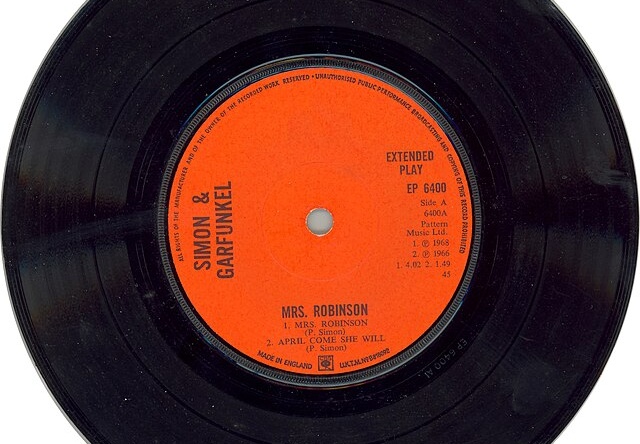
Label of the UK EP for Simon and Garfunkel – Mrs. Robinson from 1968 (the CBS logo has been removed). Licensed under Creative Commons Attribution-Share Alike 3.0
*****
What if I told you there was a real “Mrs. Robinson” — someone who once met two musicians, and before she knew it, they were singing about her by name. I know her story well, because the real Mrs. Robinson was my mom.
The Early Years
“Jesus loves me, this I know, for the Bible tells me so….” These are the first words I remember hearing from my mother. She was rocking me in the old Victorian rocking chair her mother had used for her. My first memory is centered around my mom and Jesus.
She was born Barbara Balday in 1932 at home in New York City, a sickly child who was not expected to live. Her mother had delivered four live daughters and ten stillborn sons before her. When the oldest daughter, my aunt, helped Mom enter the world, she balked at having to wash the new baby. “Oh Mother, do I have to?” she asked, “It’s only going to be dead.”
No one called her by her real name until she went to school. She was always “Tootsie” in those early years. Her role models were Jesus and Shirley Temple.
Mom’s father was 56 years old when she was born. His father was a brigadier general in the Civil War. He was a Union General who helped black soldiers put an end to the misery of slavery. My great-grandfather moved his family to New Orleans after the war, when federal troops worked to protect the voting rights of black Americans in the South.
Mom’s maternal great-grandfather also worked toward the cause of abolition. Reverend James Junius Marks was the Presbyterian pastor of a church in Quincy, Illinois. He knew Abe Lincoln and visited him in the White House. Marks volunteered as a chaplain for the Union Army, and he shared the imprisonment of the troops he served. He traveled to the Holy Land and gave lectures on what he saw where Jesus walked.
When the general’s son, my grandfather, moved back North, he met his wife in a coffee shop in Pittsburgh. She had left her family’s farm to explore city life. My grandfather said he “always admired the way Jewish people were devoted to the education of their children,” so he moved his family to New York City.
Their church had a Sunday school and a choir. The children sang In The Garden and other Christian colloquial hymns. Like some churches, it also met on Wednesday evenings. But unlike others, these meetings were known as “message services,” in which a medium would claim to “channel” the spirit of someone who had died. As it turns out, my mom was raised in a Spiritualist church.
Spiritualism was in vogue in the 1920s and 30s. It was popular because some people were looking to contact loved ones who had died in WWI. The same thing had happened on a larger scale after the Civil War. The rise of socialism, and the occultism that often goes with it, was another reason for the uptick in interest in unconventional forms of worship.
“She would give her messages during the church service,” Mom said about the woman who acted as a conduit. I thought that was pretty strange, since I was raised in my dad’s Episcopal faith, which is about as mainstream as a Protestant church could get.
Movies and Motherhood
Movies on the silver screen played an early role in Mom’s conversion. When she was 11, she watched Oscar-winner Jennifer Jones portray a young saint in The Song of Bernadette. The film is based on the book by Franz Werfel, a German Jewish man who fled the Nazis with his wife and ended up in Lourdes, France in 1940. The small town in the Pyrenees had become a major pilgrimage site eighty years before, when 14-year-old Bernadette saw the Blessed Virgin Mary there. She revealed a hidden spring that’s been known for healings ever since.
Mom was 13 when she watched luminous leading lady Ingrid Bergman as Sister Benedict in The Bells of St. Mary’s. The story of the urban Catholic school showed Bergman helping students with their problems, like teaching a bullied boy to box and a girl from a broken home to have hope for the future. These movies inspired her gentle dream: “I’ve always wanted to be a nun,” she said.
Having no religious training toward becoming a nun, and instead a closet full of beautiful clothes her mother made and glamourous postwar New York City outside her door, mom instead went on dates, and she sometimes fell in love.
She might have become Presbyterian if she had married her boyfriend from Long Island, since that’s where his family went to church. But a health issue forced him to break their engagement. My mom already knew my dad, Bill Robinson, by this time. The tall, dark-haired athlete had dated her older sister and was a favorite of her mother.
He was fluent in German and served in Naval Intelligence during WWII. Dad was a tennis player who traveled to compete when he was growing up in the South. He studied at Columbia on the GI Bill. Dad stayed in New York and worked as a tennis pro at a private club in Manhattan. One of his regular tennis partners was Bishop Fulton Sheen, the Catholic cleric widely known for his Emmy-winning TV series, Life Is Worth Living. Mom followed her sisters in working the front desk at the tennis club, so she was near my dad in the city and on weekends at another club in the Hamptons.
They were married in 1954 by a Justice of the Peace in Southampton, and they moved to an apartment in the city. My mom was surprised when she met her husband’s family in North Carolina and they all called him “Rod.” It was a family nickname he grew up with, and he started using it again in their marriage and for the rest of his life.
Mom and Rod were excited to welcome their first baby. But their joy at the birth of my brother, John, was overshadowed by a growing realization that something was wrong. Doctors confirmed that their son had a severe mental disability.
Mom spent every day rocking John in the old Victorian rocker. “All day,” she said, “from the time Dad left for work until the time he came home.” She said in her sorrow she would ponder the Pietà, the famous statue by Michelangelo that depicts the Virgin Mary cradling the crucified body of Jesus.
John never walked or talked in all his life — except once. My dad and his parents had finally convinced Mom to have John cared for in a nursing home. One day my mom visited John and took him out for a drive. Spotting a Catholic church, she brought him inside. Mom told me, “He ran down the aisle, shouting, ‘Jesus, Jesus, Jesus!’”
After their visit, they returned to the hospital where my brother lived for another twenty years without ever walking or talking, let alone running and shouting, again. It was a dozen years after John died, once Mom and I had become Catholic, that we realized what had caused the miracle: it was the Real Presence of Jesus — Body, Blood, Soul and Divinity — in the tabernacle of this and every Catholic church.
A Song Is Born
Some time later, Rod had to be hospitalized in Boston. Mom and he drove our family’s station wagon to the airport, parked it there and flew north. A live-in housekeeper watched the kids at home. Dad’s surgery was successful, but he’d need weeks of rehabilitation, so Mom flew back to New York on her own.
The plane she took had a lounge area with seats that faced each other. She went to the lounge and was visiting with the stewardess and two young musicians. “We were laughing and talking and having a good time,” Mom said.
Since her car was parked at the airport, she offered the two — one blonde, one brown-haired — a ride into the city. They accepted, and the trio from Queens got a bite to eat in Greenwich Village and spent the whole evening together.
Mom didn’t really notice it when the song that bears her name came out a few years later. Her friends told her, “That’s you!” — not just because of the name, but because the topics she led with — Jesus, God, prayer, and heaven — featured so prominently in it. It wasn’t until a few years later that everything clicked. “The TV was on,” she told me, “and there was Art Garfunkel. I said, ‘That’s him! That’s one of the musicians!’”
The lyrics of their song reflected the things Mom shared with them about her life. Mom said Dad was bad to her, that he was emotionally and physically abusive. She found solace in reading about the lives of certain saints, especially Teresa of Avila and John of the Cross. In this way, and by joining the Episcopal church, the spiritual elements of her life were becoming more mainstream. With these Catholic mystics, she found beautiful truths that nourished her.
I was four years old when my mom ended up divorcing Rod in 1969. When they were married, our family had gone to the Episcopal church every Sunday. The fallout of our broken home was far less church attendance for us. At best, we went to church every Christmas and Easter together — all of us. At worst, like when Mom moved with us kids to Los Angeles, we didn’t go at all.
My mom had been confirmed in the Episcopal church in January 1964. The denomination does not consider its confirmation to be a sacrament the way the Catholic Church does, but during the rite, a person renews her baptismal vows. These are promises she made at baptism or that were made for her by her parents and godparents. The Book of Common Prayer, which she used as an Anglican, says it is required that the confirmed person renounce Satan, repent of her sins, and accept Jesus as her Lord and Savior.
Mom was raised to distance herself from the devil. When she had been misbehaving, she was instructed to go and face the corner of the room and say, “Get behind me, Satan!” (quoting Jesus in Matthew 16:23). She would obey.
I think it’s significant that it was only a couple months after Mom’s confirmation in the Episcopal church that she met the two musicians. In the Catholic Church, the sacrament is meant to give those who receive it the strength and the grace to defend the Faith in the world. And here was my mom, enthralling two nice Jewish boys with the love of Jesus and the truths of the Christian faith after receiving just a foreshadowing of this grace.
Homecoming
Following our one sad year in California, our family moved back to New York and closer to Dad. We resumed our twice-a-year church routine and enjoyed the renewed stability.
Movies were again a source of spiritual inspiration for Mom, and now for me, too. And though Hollywood was something of a desert place by the mid-1970s, two films caught our interest. The one we saw at the local theater was called In Search of Noah’s Ark. It shows how the famed vessel may still lie atop the mountains of Ararat, just where the Bible said it landed thousands of years ago.
The other film was a star-studded affair directed by Franco Zefirelli. Jesus of Nazareth appeared on the small screen as a TV miniseries watched by an estimated 90 million Americans. It features Anne Bancroft as Mary Magdalene. She might have been paired with Dustin Hoffman again — in a much more elevated theme than their previous outing — since his was the first name floated to play the Lord. But an English actor won the role of Jesus with his striking blue eyes and resemblance to the most popular religious image of the time, Warner Sallman’s Head of Christ.
Mom and I made up somewhat for our lack of regular church attendance by watching Evangelical preachers on TV, like Billy Graham and a jowly ninety-year-old who admonished viewers to “Blow the dust off your Bibles!”
Money troubles for Mom meant that she became technically homeless when I turned 18. She went to live with my aunt in Maine for about a year, then stayed with another relative before becoming a domestic servant. It was in one of these jobs that she became familiar with the most conventional form of worship she’d encounter: the Catholic Mass.
She took a job in Washington, D.C. that she found in the classified ads of The New York Times. It was similar to others she’d had, since it involved being a companion to an elderly woman, driving her around and doing some light housekeeping.
It was different, though, because the woman was a member of the Carroll family, whose English ancestors included Charles Carroll, a Catholic signer of the Declaration of Independence and his cousin, Archbishop John Carroll, America’s first Catholic bishop. Mom loved the family, and their lively Catholic faith helped break down a cultural barrier that might have kept her from joining the Church sooner.
In New York, there was a tendency to equate Catholicism with certain ethnic groups, like the Italians and the Irish. Many parishes were known by these identities. Since, as Episcopalians, we could be said to have our own ethnic church, there didn’t seem to be a need to make a change. And the liturgy of the English church is maybe the closest to Catholic among the various Protestant groups.
My mom’s job was to bring Mrs. Carroll to daily Mass every Wednesday. With any perceived cultural obstacle removed, my mom took to the faith like a fish to water. She visited the National Shrine of the Immaculate Conception, North America’s largest Catholic Church. She met with a kindly priest there and told him she had always wanted to be a nun. “That’s fine,” he chuckled, “but first, you have to be Catholic.”
Conversions
A wedding in the family in 1990 figured into our conversions. The newlyweds chose Yugoslavia for their honeymoon. They said it was someplace different and more affordable than other spots in Europe. The bride and groom ended up on a plane full of Catholic pilgrims, all headed to the latest place the Blessed Virgin Mary had supposedly been appearing to children. The pilgrims coaxed the couple into adding the little Bosnian farming village of Medugorje to their journey. They stopped in at the village church and lit a candle, and that was that.
But after they returned to America, everyone in our family started going to church on Sundays again — all of us, in three different states. Mom entered the Church in Washington, D.C. at the Easter Vigil in 1993.
My return began at St. Anne’s Episcopal church in Lowell, Massachusetts. It’s around the corner from the Catholic St. Joseph the Worker Shrine, and I beat a path between them. I was engaged to be married at the time and was working in radio news. My fiancé joined me at St. Anne’s and in church together ever since. We were given the grace of chastity and taught Sunday school, and were married at St. Anne’s Episcopal church in 1995.
Mom, who had always loved Jesus, now fell in love with Mary. She talked about Our Blessed Mother to everyone, the same way she talked to her two musicians thirty years before. We listened, and we were changed by what we heard.
Eventually, I met a blue-eyed lady from France at a Catholic shrine, and she taught me about the Exposition of the Blessed Sacrament. It’s when the large white Host from Holy Communion is placed in a stand called a monstrance for devotion. It reminded me of an old-time radio microphone.
She and I sat on a curb near the shrine while she read to me from the book of messages from Mary received by an Italian priest. I remember her turning from the book to say, “I hate to tell you this, but you’re a heretic.” I thought she was probably right. That’s the way it is for Protestants as we get closer to Mother Church. When we start learning about the Catholic Church, and start to believe it’s the Church founded by Christ, it becomes important to enter it, or else risk rejecting God.
It’s been said there are two ways to enter the Church: by marrying a Catholic, and by reading your way in. I started with a book by Bishop Sheen when I was seventeen. I pulled On Being Human from the shelf of my local library because it sounded like the titles of the philosophy books I was reading at school. That’s when Mom told me Dad used to play tennis with the author.
I read books about Padre Pio and The Life of Mary As Seen by the Mystics. I read best sellers, like the new Catechism of the Catholic Church and Crossing the Threshold of Hope, which has Pope John Paul II answering questions posed by a journalist.
When my husband and I moved to Maine, Mom was in Massachusetts, and she visited us often. She spotted a Catholic Church while driving around with me, and said, “Let’s go in.” We saw there was a prayer group on Tuesday evenings and she encouraged me to go. I did, and I met ladies who taught me more about the Catholic Faith.
John and I were still Episcopalian, and we went to St. Peter’s church in Portland. Its style of worship is “high church” or Anglo-Catholic. There was a weekly Rosary group, and I hoped the whole congregation might convert. This had been happening in some places after John Paul II issued the Pastoral Provision in 1980.
“We’re even going to have exposition of the Blessed Sacrament!” I told my friends after a prayer meeting at their Catholic church. One lady asked, “Where are you going to get it?” I realized that she believed that the communion in our Protestant church was not the same, was not genuine. Her response was hard to hear, even though I felt she was right. It was another example of the pain of separation.
After our son was born in 1997, we went back to St. Anne’s Episcopal church in Massachusetts for his baptism. We brought him to church in Portland and to the Catholic prayer group in the neighboring town of Scarborough. The lady who ran the prayer group asked when we would be coming into the Church. I told her, “Find us a priest.” Soon she called to say there was a new Polish pastor of a church in Portland.
The next Sunday our little family got into the car to drive to the Episcopal church as usual, except the car wouldn’t start. So we stayed home that morning and saw the car’s not budging as a sign that now was the time to make our move.
Two weeks later, we climbed the stairs of the upper room church in Portland and never looked back. The priest from Poland instructed us himself and brought all three of us into the Catholic Church just a couple of months later, at the Easter Vigil in 1999. My husband’s sponsor was my mom.
Since then, we’ve been part of Catholic homeschooling groups, enjoyed a yearly slice of heaven at All Saints’ parties, and hosted charity baby showers for expectant moms in need. My own mom wanted us to be lay missionaries, but we were too homey to go very far. So for the last two decades, we’ve walked across town to the local nursing home to pray the Rosary with the residents there.
Mom became a full-time grandmother on Cape Ann, Massachusetts, entrusting her work to the Patroness of Grandmothers and Homemakers, to the mother of the Blessed Virgin Mary, St. Anne.
My dad couldn’t walk anymore, and Mom helped find a nursing home for him near her, and she cared for him until his death in 2001. Mom entered a nursing home herself eight years later, after suffering a massive stroke. About a month before she died in 2016, Mom sat up and smiled at the empty air next to me and said, “Why Bill, what are you doing here?” I think she saw the youthful version of my dad, the one she fell in love with. She died between the feast days of two great saints, Mary Magdalene and Anne.
The church right down the street in our suburb of Portland is also called St. Anne’s. This one is Catholic. We celebrated 25 years as Catholics this past Easter, and we’re very happy to be home.
I’ve been working on the biography of the real Mrs. Robinson for the last five years. I’ve given author talks at local libraries and even at my hometown library in New York. We enjoy the wide audience that Mom’s name attracts, and we’re glad the book isn’t preachy or too theological for the average person. Catholics are using it as a tool for evangelization. Some people say they’ve read the book twice, and others tell us they’ve given out four or five copies to family and friends.