When I was about four years old, my older sister and I would play in the nursery while our parents had choir rehearsal in the basement of our Presbyterian church in southside Richmond. When 8:00 PM came, we were to turn off the lights and meet up with them in the choir room to go home. Darting as fast as I possibly could through that expansive, dark sanctuary to reach the back stairwell, I always felt a sheer terror that followed and consumed me. This was the source of my unrelenting fear of the dark for four decades, until the day I found an unexpected cure.
I was born in 1976 in Richmond, Virginia to faithful Christian parents. My father was an immigrant from England, and my mother was born and raised in southwestern Virginia. My Virginian ancestry on my mother’s side dates to the 1600s on her paternal side, when Scottish Presbyterians settled in the Blue Ridge Mountains, and in 1714 on her maternal side, when our German Lutheran ancestors settled the first Germanna Colony in what is now Orange County, Virginia.
In the early 1980s, my parents had “online friends” before social media was a thing. They met people using Morse code as Amateur Radio Operators. One of these friends lived in a monastery. My dad told me that their friend communicated in Morse code as a way to circumvent his vow of silence. I don’t know if that was really true, but it made for a good laugh. We visited him, and I thought he had it made. He got to devote his entire life to prayer and worship! I knew somehow that the female equivalent to this was being a nun, so I told my daddy that I wanted to be a nun one day. He just laughed and said, “You can’t be a nun; we’re not Catholic.” So as young children do, I shrugged it off and went about my happy little life.
I spent my childhood first in a Presbyterian church in southside Richmond. Then, when I was seven, we moved out to the suburbs in Midlothian, Virginia, and became members of a church which was an ecumenical gathering of both Presbyterian and Methodist denominations. I always marveled at the man up in that big pulpit at church—how eloquently he spoke with so much authority about the things of God. If I couldn’t be a nun, I wanted to be like him. As the years went on, however, it was not lost on me that I never saw a woman in a pulpit. But in my early days of middle school, one Sunday we walked into church, and there she was—a woman in a robe and stole! If I recall correctly, she was a seminarian who was completing a summer internship to be our associate pastor. That sealed the deal. My calling was confirmed.
Just as most life stories move along with twists and turns, my past to present was not a straight “point A to point B” line. As I entered my teen years, I went down the path of rebellion. At age 16, five days before my senior year of high school, I became a single teen mom to a beautiful baby boy. My dreams of seminary had long been shoved down into the recesses of my heart, and now any thought of advanced studies after high school was out of the question. After all, I had a child to raise.
I’d like to be able to say becoming a mother instantly caused me to mature and put my rebellious phase behind me. After high school, however, I found every chance I could to have parties at my apartment, while my toddler would often stay overnight at my parents’ house. I never rejected my belief in God, but focusing on Him was far from my mind. I was not active in church for several years. By age 20, however, I realized that I needed to focus on being a good mother, and I left the partying behind. But the rest of my rebellion remained intact, and I moved out of the state.
Seeking to Rekindle the Faith of My Youth
In 1999, in my early 20’s, I again gave birth, this time to a beautiful baby girl. Life was good, but the faith of my youth was an ever-glaring void. I decided to have the kids baptized at my home church in Virginia and then began to seek out a local congregation in central New York, where we were now living. I wasn’t sure if I wanted to stick with the Methodist church, which was the most prevalent tradition in my upbringing, or seek out another church. At this point in my life, I had no concept of the differing theologies of the various Protestant denominations. I had John 3:16 and Psalm 23 memorized, and I loved Jesus. That was about the extent of what I had retained from my childhood.
While the small town where we were residing was about 85 percent Catholic with several small Protestant denominations scattered around the area, the Catholic Church was never an option. I’m not sure why, but from that very first time my father told me I couldn’t be a nun, I didn’t even know I could become Catholic! My elementary understanding of our Christian “ancestry” was that it originated with Jesus and the Jewish people, then the Catholic Church took the reins, then came the Protestants. My father was a naturalized U.S. citizen from England and anti-Catholic. I don’t remember him ever besmirching Catholics directly; after all, he had that Catholic friend in the monastery. He did, however, make us wear orange on St. Patrick’s Day, “in protest of the Catholics,” when we were kids. Beyond that, Catholicism just wasn’t anywhere on my radar.
I loved to sing and began listening to Christian radio. I had visited a Nazarene church with some friends as a teen where the music had been more modern, so I decided to attend the local Nazarene church in central New York, and it seemed like a perfect fit. A few weeks went by, and I received a knock on my door. The pastor was standing on my front porch with a cassette tape in his hand: music by a vocal group called Phillips, Craig and Dean. He said he had heard me singing from the pews and asked if I could learn this song and sing it as a solo in church the following week. I happily accepted. If there was one thing that was a constant in my life, it was singing. I am rather shy, and maybe even a bit socially awkward, but put me in front of a crowd with a microphone, and I’m at home. Nevertheless, my time at the Nazarene church was short-lived, and I ended up back in the familiarity of the Methodist church.
Once I began participating in church life there, I was all in. I joined the choir and started attending the adult Sunday school class. Eventually, I was asked to teach the class. I also served on the church council. As I had mentioned, we were a small town with a heavily Catholic population, so our church membership numbers were very low—less than 100 attendees on most Sundays. We could not afford the apportionments to the conference (funds from our tithes which were due to the regional administration), so we were only assigned a part-time pastor. After I had been a member for about a year, I was asked to deliver sermons and lead worship as a lay minister on the Sundays when our pastor was preaching in the neighboring towns. I couldn’t help but feel that this was the way I was answering the call I had left behind as an unrealized dream so many years before.
Seeking to Grow in Knowledge and Faith
I began studying Scripture a great deal in order to write sermons and Bible studies. Not knowing anything but sola Scriptura (the Bible alone being the only necessary teaching for faith and practice) and having no point of reference for the correct way to interpret Scripture, I quickly came to a very literal, fundamentalist viewpoint. I was convicted of many things through my studies, one of which was that I thought, since I am a woman, I should not be leading men in worship. I began seeking out others who were seeing the same things in Scripture and started participating heavily in online Bible study message boards. I eventually left the Methodist church, and in 2004 found myself a member of a very conservative branch of the denomination called the Church of Christ.
My immersion into scriptural study, almost to the point of obsession, took a huge toll on all my relationships. I was completely withdrawn from anyone not connected to the Church of Christ. The kids and I moved to Texas, where we had more of a support system among my new Church of Christ friends. Church life was all there was in my world. I wrote and led many women’s Bible studies and delivered lectures to women at a few conferences in the Midwest. I led singing at “Ladies Days” seminars and helped lead the youth group. A friend and I were co-founders of a Bible study message board online, where people would come and learn (and heavily debate) our Church of Christ doctrine. Within this denomination, I felt like I was doing a lot of good for the kingdom of God. The problem that always plagued me, though, was that I was being taught that anyone who was not in this denomination was not really Christian, and barring their conversion into the “one true church,” they would not make it to heaven. I felt in my heart that this was not true. I knew my parents and others in my family were Christians, and that it was not our place as humans to judge the fate of someone else’s soul. I also had questions that I never could seem to reconcile, mostly surrounding believer-only baptism versus infant baptism, which the Church of Christ wholly rejected. What I grieved the most, however, was the lack of unity I was seeing among all the various denominations I was learning about or in which I had been involved. After all, Jesus prayed for unity in John 17. Broken-hearted, I finally left the Church of Christ in 2008. I tried to cling to my Savior, but in my frustration, He felt so far away. I put my Bible on the shelf.
The kids and I moved back home to Virginia. Beginning around 2010, we visited a few churches in the area. Nothing felt quite right. I was having trouble breaking away from my fundamentalist views. I found something “wrong” with every church I attended. It wasn’t until I began going to a local Non-denominational megachurch in 2015 in Powhatan, Virginia, that my relationship with Jesus came back to life. I sat in the back and just listened for almost two years. I was reminded of the principles of my youth—that Jesus loves me, and that God my Father never left me, even though I had felt empty for several years. In 2018, I began studying Scripture again. This was the first time (sadly) in about nine years that my Bible came off the shelf. In 2019, I finally answered the call to be in lay ministry once again. I was singing with the worship team, teaching new member classes, and volunteering with the prison ministry, where we would take “church inside” to those serving time at the nearby correctional facility.
One thing I loved about this church was that it was very “generic.” I don’t say that in a derogatory sense at all. On the contrary, I felt I could hold my own views and still commune with others there who might believe differently on some theological matters. The statement of faith contained very basic core principles of the Trinity, the practice of baptism, and the Bible being the inspired Word of God. They represented themselves as a church existing “for people who don’t go to church, so that we can all live the fullest lives possible through Jesus Christ.” I could get behind that at this point in my spiritual walk, despite having some very strong theological beliefs which I’m sure differed from many in the leadership. Despite the baggage we came with, we all had that common bond—our love for Jesus.
For me, this was fine—until it wasn’t. Sometime around the beginning of 2021, the material I was using to teach the new members class was updated with a “plan of salvation,” which included the “sinner’s prayer” as the means for becoming a Christian. This was something with which I had always wrestled in Evangelical churches, because I always believed Scripture taught very plainly and clearly that baptism is the means through which one becomes a Christian. Since I felt like I could no longer teach new members, lest they ask me questions about the plan of salvation laid out in our booklets, I stepped down from leading the class. This began yet another internal theological crisis within me, as seemed to be my pattern in life. I also stepped down from my leadership role on the worship team. By the spring of 2021, I had stopped attending completely.
A “Dark Night of the Soul”
This began a very empty time for me. You might call it my own “dark night of the soul.” I had to re-examine my faith and discern where the Lord was going to lead me from there. I wrestled again with the prayer of unity that Jesus prayed in John 17 and kept wondering, “Why are so many faithful, Jesus-loving Christians coming to so many different conclusions on what the Bible says? What if everyone else is right and my personal beliefs are all wrong? Surely there is an authority somewhere who can discern the teachings left to us through the Holy Spirit!” I returned to a local Church of Christ for a few months, then quickly remembered why it wasn’t for me. So, in the early part of 2022, I once again found myself spiritually homeless, attempting to find purpose and meaning while relying on online church services to be fed some spiritual nourishment.
Then something radical happened in my life. Following a family reunion over the summer of 2022, which ended with a visit to my mom’s old childhood church with all its beautiful stained glass and reverent glory, I had this notion that I needed to study our Christian roots—the history of the Church. What did the early Church Fathers believe and practice? I could write a novel about what I have discovered and have continued discovering since then, but for the sake of brevity, I will just say that I concluded that if the early church was so Catholic, then why was I not?
Finding Light on the Journey from an Unlikely Source
Throughout my journey, I never had that one specific date and time I can pinpoint to say “this is when I gave my life over to Jesus Christ.” I was brought into a Christian family from birth, baptized at six weeks old, and never strayed from at least a nominal faith in Jesus throughout my entire life. Sure, I had some emotional mountaintop moments, usually at a Christian concert or while singing beautiful four-part a cappella harmony with a full congregation, or staring up at the summit of my favorite mountain in the Colorado Rockies. But my faith has always been more intellectual than spiritual. I learned the Bible and I believed it, but I didn’t “feel” it. God was “up there,” we are “here,” and Satan is “down there.” Over those two years of seeking and reflection, I had been asking God more and more, “Why don’t I feel your presence?”
Around the start of fall 2022, as I was beginning to really dig in and discern the Catholic Faith more diligently, I decided to try to pray the Rosary. I had found that Catholics have a deep spiritual connection to God the Father, Son, and Holy Spirit, as well as to the saints in heaven—especially our Blessed Mother, Mary. I figured if I could find that same connection, perhaps the closeness I desired with God would come. Sure, it was a bit strange to pray the Rosary as a Protestant, but I was desperate to feel God’s presence. I got down on my knees, and I stumbled through the Joyful Mysteries of the Rosary using a guide I had found on the internet. I felt such a peace come over me that I can’t put into words.
I didn’t think much about it, until later that evening. I approached a dark room in my house. I went to turn the light on, and it didn’t work. I mentioned at the beginning of my story that the fear of the dark had never left me since I had to run through that dark sanctuary as a very young child. It hit me at this moment—I had NO FEAR in this dark room. It may sound odd for a woman in her mid-forties to speak about being afraid of the dark, but this sheer terror that I had carried with me since I was four years old was suddenly completely GONE since the day I prayed my first Rosary. A passage of Scripture then came to mind at that moment, “The light shines in the darkness, and the darkness has not overcome it.” (John 1:5) I don’t know how to explain it, but if what I needed was proof of the validity of the intercession of the Blessed Mother, the saints, the protection of angels, or anything else I used to doubt, I found that spiritual connection with the whole heavenly host that day! My once “intellectual only” faith had finally blossomed into a spiritual devotion that points more completely toward my Savior, Jesus Christ. His mother — our mother — pointed me to Him. She confirmed for me, through the peace I found in that first Rosary prayer, that I was on the correct path. I finally “felt” the presence of God in my life. “In him is no darkness at all” (1 John 1:5b).
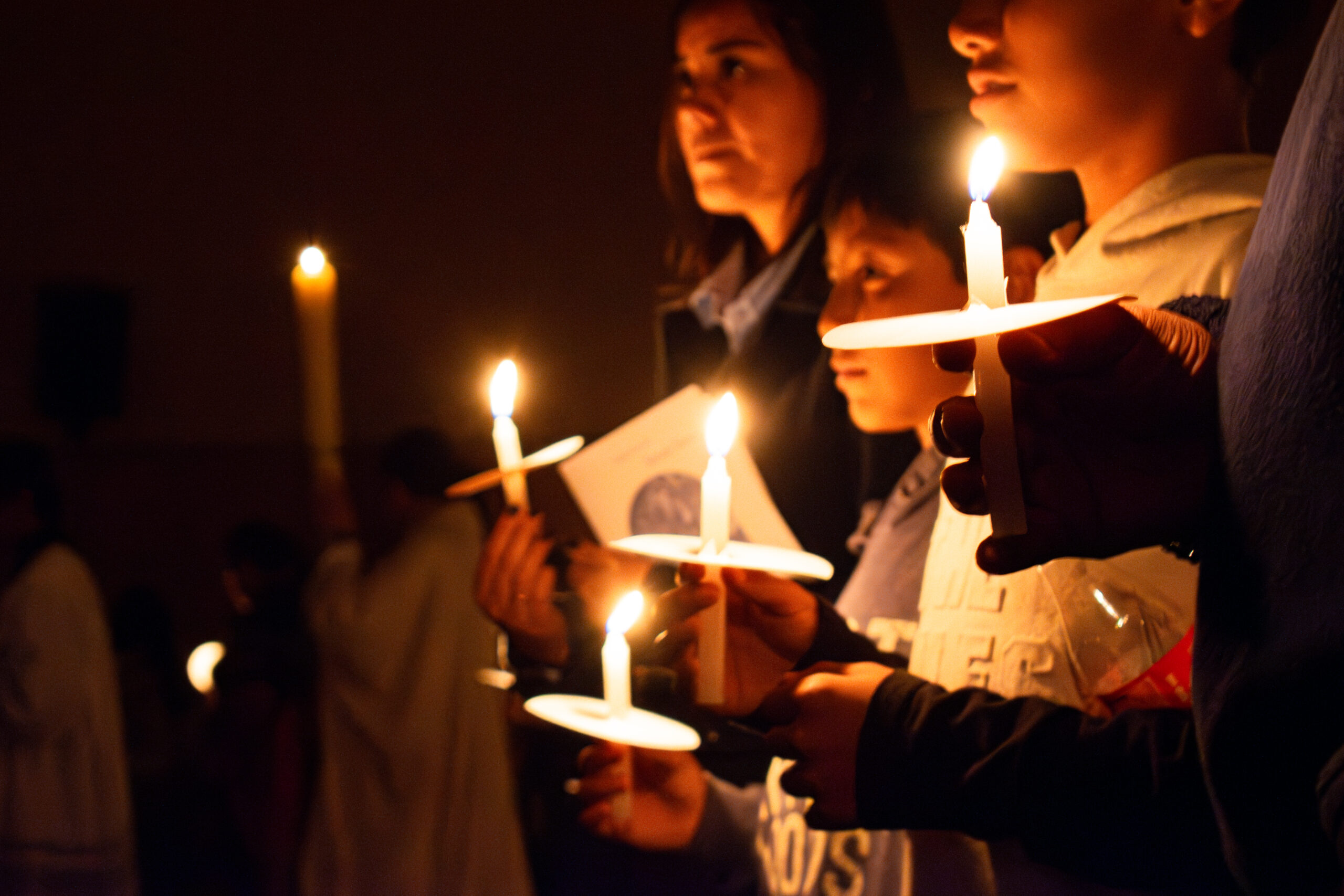
Within a few days, I reached out to my local Catholic parish, got enrolled in RCIA and began attending Mass. I was finally home; I never looked back. There was nothing left to do but to be received into full communion at Easter Vigil, April 8, 2023!
Before I even knew that I would one day begin this journey, my conversion was influenced by the simple life of the monk I met as a child, news stories of a heroic little woman named Mother Teresa, a Catholic woman who helped me at a crisis pregnancy center when I was 15, and a Catholic friend on a Christian message board who was a spiritual beacon of light when I was so bent on debating fundamentalist doctrine. Hindsight shows many experiences along the way of faithful men and women who had me in awe of what it meant to be Catholic. With my own experience that night of my first Rosary prayer, my soul has been filled with so much grace and light on this journey.
While becoming Catholic, I learned about vocations. I had this desire deep in my soul from the time I was a very small child that I had no idea what to do with. My calling was to religious life, even though I had no words or context for this. In a Protestant Christian home, it was always a given that I would grow up, get married, and become a mother. I failed miserably at marriage, but my kids are still my crowning glory. As a single person, I am focusing on caring for my mother, who has Alzheimer’s, and helping my daughter care for her daughter. I also plan to begin discerning with a secular religious order in the near future. I enjoy attending Mass several times a week, being a cantor, and helping to facilitate women’s Bible studies at our parish. I am finally discovering that “fullness of faith” I have been searching for my entire life—and I have found it in the Catholic Church.