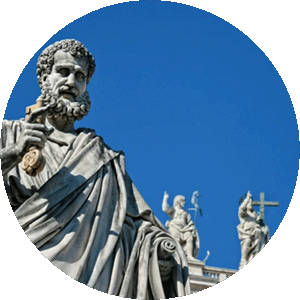
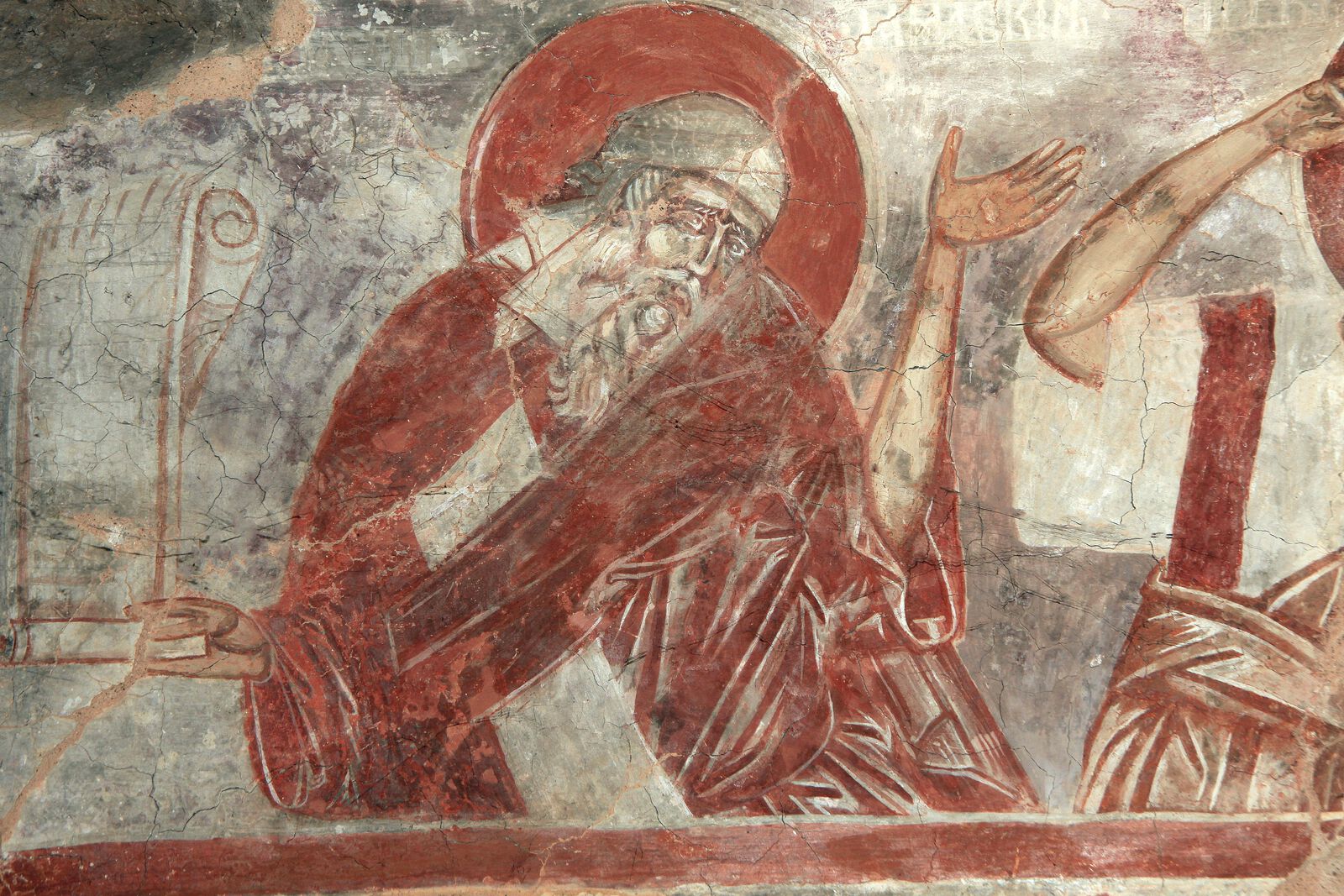
One of the most common Protestant criticisms of Catholic devotional practice is the use of images as aids for prayer. And while many of our Protestant brothers and sisters are comfortable with showing children flannel graph depictions of Noah’s Ark, or even having members of the congregation portray the events of Christ’s life in an Easter play, the idea of icons or statues of Jesus, the saints, and especially the Blessed Virgin Mary, can evoke a visceral reaction and an accusation of idolatry.
During the Protestant Reformation, there was a widespread iconoclastic movement, especially among Calvinists, to go into Catholic churches and smash statues and stained glass, believing that these visual depictions of the faith violated the Ten Commandments. This impulse was so strong that to this day, the list of the Ten Commandments often differs, depending on whether it’s posted in a Protestant or Catholic context; in the Catholic tradition, the law against creating graven images is included within the First Commandment of having no other gods other than the Lord, whereas in the Protestant tradition, the reference to graven images is separated into its own commandment.
However, the historical controversy over visual depictions of the faith is not confined to the era of the Reformation. In fact, it goes back at least as far as the Iconoclast debate that was already raging by the time St. John Damascene was born in the latter part of the 7th century.
There were many reasons that icons had fallen out of favor in certain parts of the Christian world, among them the rise of Islam, which rejected any visual representation of holy figures, including Mohammed. There were also Iconoclast Christians who, emboldened by the support of the Byzantine emperor Leo III, were actively tearing down and destroying icons.
Into this world was born St. John Damascene, also known as St. John of Damascus (Feast Day: December 4). Because his hometown of Damascus was at the crossroads of the Islamic and Christian worlds, he was well acquainted with the debates of the day, and understood both the desire of Muslims and Iconoclast Christians to defend God’s honor by destroying images, and the historic Christian practice of honoring God by depicting His marvelous deeds through art.
For St. John’s part, his defense of the depiction of Holy Images was rooted in the reality of the incarnation of Jesus himself:
“Previously God, who has neither a body nor a face, absolutely could not be represented by an image. But now that He has made himself visible in the flesh and has lived with men, I can make an image of what I have seen of God… and contemplate the glory of the Lord, His face unveiled.” (As quoted in the Catechism of the Catholic Church, para. 1159)
Depending on what strain of Protestantism one comes from, there can sometimes be a bit of culture shock when walking into a Catholic parish full of statues and stained glass; in recent decades there has been a movement within low church, seeker-friendly Protestantism to avoid the depiction even of bare crosses in their worship spaces, as a way to demonstrate sensitivity toward visitors who might not yet feel comfortable in an overtly Christian setting.
But St. John reminds us that even the very words we speak about God call to mind tangible images as a way of understanding His mystery by way of analogy:
“We see images in creation which remind us faintly of God, as when, for instance, we speak of the holy and adorable Trinity, imaged by the sun, or light, or burning rays, or by a running fountain, or a full river, or by the mind, speech, or the spirit within us, or by a rose tree, or a sprouting flower, or a sweet fragrance.” (On Holy Images)
In fact, some of St. John Damascene’s words to the iconoclasts sound as though they could be lifted right out of a debate today over the use of images in prayer:
“I do not worship matter, I worship the God of matter, who became matter for my sake and deigned to inhabit matter, who worked out my salvation through matter. I will not cease from honoring that matter which works for my salvation.” (On Holy Images)
Ultimately, the Catholic way of looking at the world is to see it first as created good by God. Through the incarnation of Jesus, and His institution of the sacraments, visible and tangible things have been given a new dignity. By depicting Our Lord, His mother, and the holy men and women who have modeled the Faith through the centuries, we are reminded not just in our minds, but through our senses, what it means to follow Christ.
As St. John Damascene himself put it, “Because of [the Incarnation], I salute all remaining matter with reverence.” (On Holy Images)
St. John Damascene, pray for us!