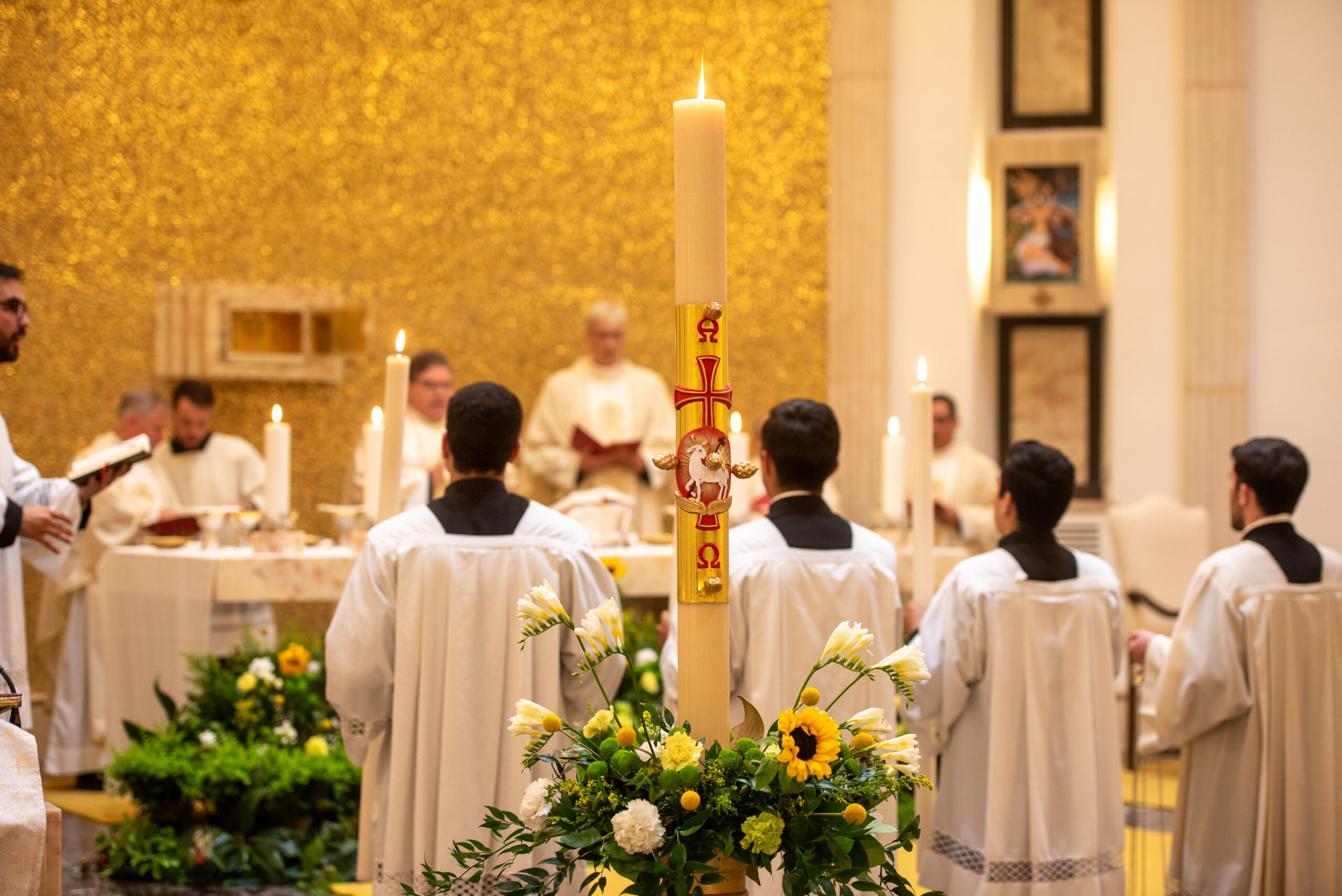
“Instructed masses” are not so common these days, but they are a wonderful way for a new Catholic to learn about the Mass and its parts while participating in its celebration. Of course there are many handbooks available to explain what happens at Mass, but there is something special about being on the journey of discovery together with our spiritual family.
The Church has always called her sacraments mysteries, and the work of helping the faithful to understand these mysteries is called mystagogy (initiation into the mystery). It is so important that the faithful know the hows and whys of the celebration. Pope Benedict XVI said that “the mature fruit of mystagogy is the awareness that one’s life is being progressively transformed by the holy mysteries being celebrated” (Sacramentum Caritatis, 64). In the modern Church, mystagogy traditionally extends throughout the Easter season (concluding at the feast of Pentecost) as a period of accompaniment for new Catholics, helping them to explore more deeply what it means to fully participate in the sacramental mysteries of the Church.
Mystagogy goes back to early Christian times, when it had a special significance. Pagans were curious about what was going on inside the Christian assemblies and not always for the right reason. Thus, the early Christians observed the disciplina arcani (the discipline of the secret), when only the baptized were permitted to be present during the celebration of the sacraments and were instructed not to talk about it on the outside. St. Basil the Great taught that there are mysteries that should not be told to the uninitiated, lest they be profaned (On the Holy Spirit, 27.66). We’ve certainly come a long way from that time, with our live-streamed masses and Eucharistic processions and the way we interact with each other digitally!
But mystagogy also had a real catechetical purpose – to prepare the catechumen to receive the sacraments properly. “The mysteries must be experienced as well as lectured on,” St. Ambrose taught. That is why they waited until after baptism. “To have given a reasoned account of the mysteries earlier would not have been right, for in a Christian man, faith must come first” (On the Sacraments, 1.1.1; On the Mysteries, 1.2).
Perhaps the foremost Christian mystagogue was St. Cyril of Jerusalem, who in the mid-fourth century delivered five mystagogical lectures to the newly baptized in the days after Easter. Three of these were about the rite of baptism and two about the Eucharist. In the fourth lecture, Cyril speaks of how the bread and wine are truly transformed into the body and blood of Christ, supported by many references from the Old and New Testament. The fifth lecture is a guide to the parts of the mass after the offertory, with an emphasis on the sense of awe when the deeper meaning of these rituals is perceived. “You must never deprive yourself of these holy and spiritual mysteries because of your sins” (23).
Egeria’s Diary of a Pilgrim from this time describes the time of mystagogy at the Church of the Holy Sepulchre in Jerusalem: During Easter week, after the Eucharist, the bishop leads the faithful to the Anastasis (the place of Jesus’ resurrection), and the doors are closed to everyone else. “While the bishop is discussing and explaining each point, so loud are the voices of praise that they can be heard outside the church. And he explains all these mysteries in such a manner that there is no one who would not be drawn to them, when he heard them thus explained” (47).
In Sacramentum Caritatis, Pope Benedict XVI taught that mystagogy is crucial so that we do not fall into ritualism by treating the sacraments as something mechanical. An interior faith is needed. The process of mystagogy should have three elements (64):
- Interpreting the rites in light of the events of salvation by learning to walk with Jesus;
- Understanding the meaning of the signs contained in the rites;
- Bringing out the significance of the rites for the Christian life in all its dimensions.
The Holy Father spoke of how the outward signs of reverence (such as kneeling during the central moments of the Eucharistic prayer) open our hearts to receive Christ (64). He quoted St. Augustine: “No one eats the flesh of Christ without first adoring it” (On the Psalms 98.9).
Mystagogy, the Catechism of the Catholic Church teaches, “aims to initiate people into the mystery of Christ by proceeding from the visible to the invisible, from the sign to the thing signified, from the ‘sacraments’ to the ‘mysteries’” (CCC 1075). Mystagogy thus helps us to be more aware of our place in the celebration of the mysteries and how our lives are enriched by their effects, as Christ truly becomes present to us. One of my favorite passages from the Church Fathers, from St. John Chrysostom’s On the Priesthood, expresses this so well:
“When you see the Lord sacrificed and lying before you, and the priest standing over the sacrifice and praying, and all who partake being tinctured with that precious blood, can you think that you are still among men and still standing on earth? Are you not at once transported to heaven, and, having driven out of your soul every carnal thought, do you not with soul naked and mind pure look round upon heavenly things? Oh, the wonder of it! Oh, the loving-kindness of God to men! He who sits above with the Father is at that moment held in our hands, and gives himself to those who wish to embrace and receive him …” (III.4.177).