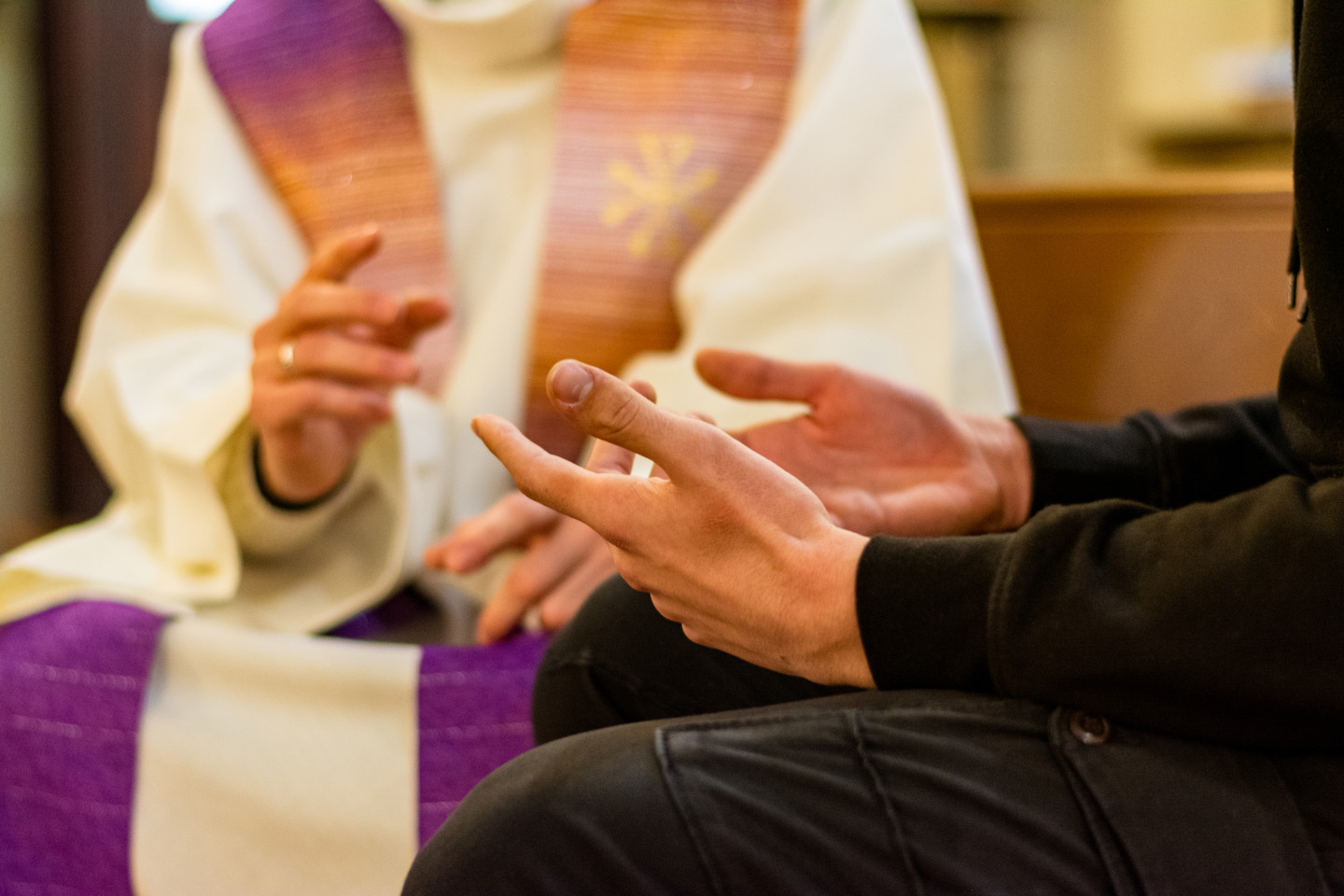
Over the past few months I have been preparing my daughter, Philomena, to make her first Confession. My wife and I have been helping her memorize the Act of Contrition, practice an Examination of Conscience, rehearse the sacrament step by step, and visit the church on Saturdays to watch her siblings line up, enter the confessional, and say ‘sorry’ to God.
Recently, we were watching a video together about Confession, and we reached the step of the process when the priest assigns a ‘penance’. “What is penance?” the video asked. “It is a small act of love”. This simple but profound description was helpful in explaining the concept of “penance” to my eight year old. As I have continued to reflect upon it, I have come to appreciate how the definition—”a small act of love”— cuts to the heart of what the Sacrament of Reconciliation—and penance as a part of it—truly are.
Many members of the Coming Home Network are learning about the Sacrament of Reconciliation in OCIA as they prepare to enter into full communion with the Church this Easter. Part of the catechesis on confession concerns the three acts on the part of the penitent: contrition (being sorry for your sins), confession (telling them to the priest who is acting in persona Christi), and satisfaction, also called simply “penance” which is a “small act of love” to be performed after you leave the confessional.
Catholics, both cradle and converts alike, will sometimes poke fun at “light penances” given in the sacrament. After a grueling session, pouring out one’s heart and sharing one’s most embarrassing sins, most of the time, the priest will say something like “For your penance, Pray one Our Father and one Hail Mary.” What? That’s it? This prescribed small act of love often offends our sensibilities. “I got off way too easy!” we might think. But the smallness is a feature, not a bug.
While we might recognize intellectually that the forgiveness we receive in confession is something totally undeserved, still there is perhaps a part in each of our prodigal hearts that wants to try to earn back our Father’s love through effort. In his apostolic exhortation, Reconciliation and Penance, Saint Pope John Paul II drew attention precisely to the nature and purpose of the “Satisfaction” or “Penance” assigned in the confessional. He writes:
What is the meaning of this satisfaction that one makes or the penance that one performs? Certainly it is not a price that one pays for the sin absolved and for the forgiveness obtained: No human price can match what is obtained, which is the fruit of Christ’s precious blood.
The forgiveness we receive in confession is of infinite value. The point of penance after confession is not to somehow try to “earn” the forgiveness we just received or to somehow “square the books” with God. What, then, is the point of penance? The catechism explains:
But sin also injures and weakens the sinner himself, as well as his relationships with God and neighbor. Absolution takes away sin, but it does not remedy all the disorders sin has caused. Raised up from sin, the sinner must still recover his full spiritual health by doing something more to make amends for the sin: he must “make satisfaction for” or “expiate” his sins. This satisfaction is also called “penance.” (CCC, 1459)
Rather than being an attempt at repayment or self-justification, penance is the medicine, prescribed by the Church through the priest, through which the penitent is invited to cooperate with God’s grace and freely involve himself in the necessary healing process.
This brings us back to penance being a “small act of love”. Whatever form the penance might take—the catechism mentions “prayer, an offering, works of mercy, service of neighbor, voluntary self-denial, sacrifices, and above all the patient acceptance of the cross we must bear” (CCC 1460)—it must be a fully free and personal act of charity that primes your heart for more. God’s goal is not just for you to “not sin” but to learn and grow, by His grace, to love as He loves, and this takes your willing cooperation and practice. You are rehearsing a new pattern, not just with your words or external action, but with the very dispositions of your heart.
But this brings us back to the question of the “smallness” of penance. For many years, when I would hear saints such as St. Therese of Lisieux talk about doing “little things with great love”, or when Our Lord invokes ‘smallness’ in parables like the widow’s mite or mustard seed., etc—I would receive such notions with a haughty attitude of “Well, perhaps start small if necessary—but bigger is better!” What I have come to realize over time, through the humbling experiences of my own sinfulness, is that I have it all wrong. I must do little things with great love because the little things are the only things I am capable of doing out of love. Why? Most of what I do, most of the time—even the ostensibly “good” things I do —I do from a heart that is impure. There is love for God and neighbor in there somewhere, but it is mixed in with pride, fear, selfish desire—a whole cadre of other motives and reasons for doing the things I do. How do I know this? Because as soon as the pressure is off, when no one is watching, when there is no immediate gratification to be had or penalty to be faced—how quickly do I fall back into my old ways.
The beauty of small things—humble things, hidden things— is that they give us the opportunity to do them simply, purely out of love. I think perhaps it is these little opportunities—the impossibly small acts of love, should we choose to accept them— that can really break our hearts of stone and make way for the hearts of flesh God wishes to give us.
As we continue the journey this year through the lenten season—a special season of “penance” in preparation for Easter—let us humbly embrace the sacrament of confession and joyfully rededicate ourselves to the small acts of love that, by God’s grace, bring healing to our hearts and make us more like our Savior.